Artificial Intelligence (AI) and Data Science
The College of Education is actively engaged in Purdue University’s Strategic Initiatives surrounding Artificial Intelligence (AI) and Data Science. The College’s AI Working Group guides and coordinates the College’s current and future efforts in these quickly evolving areas.

Overview

Transforming Learning and Teaching
We offer courses, graduate certificates, and degree programs that provide training for students in the analyses of large sets of numerical, textual, and multimodal data and practical applications of AI tools. In addition, we are leveraging our comparative advantage in P-12 education to provide professional development and training to our school-based colleagues. The College is home to faculty scholars, centers and funded grant projects engaged in interdisciplinary research to leverage AI tools and to collect and analyze data that seeks to transform learning and teaching, inform policy and make a difference in the lives of culturally and linguistically diverse students, families and communities.
Working Group
Research

Driving AI Research in Education
Development of an Undergraduate degree concentration in Applications of Artificial Intelligence in Learning Science and Engineering
- $40,000
- Innovation Hub
- Amogh Sirnoorkar, Sanjay Rebello, and Lynn A. Bryan
Promoting Equity and Research Using Adaptive Testing to Support Individualized Instruction at Scale
- $499,867
- National Science Foundation
- Hua Hua Chang
- 10/2023-9/2025
Collaborative Research: Individualizing Instruction and Improving Research using Adaptive Testing (i3RAT)
- $158,416
- National Science Foundation
- Hua Hua Chang
- 09/2022-08/2024
- $2,969,894.00
- National Science Foundation
- Yan Ping Xin, Ron Tzur, Luo Si
- 2008-2015
- More info
AI Education Integration in South Korea, Taiwan, and the United States
Faculty
- Wanju Huang, Department of Curriculum & Instruction, Purdue University
- Sunnie Watson, Department of Curriculum & Instruction, Purdue University
- Bill Watson, Department of Curriculum & Instruction, Purdue University
Doctoral Students
- Chi-Jia Hsieh, Department of Curriculum & Instruction, Purdue University
- Seoljoo Kang, Department of Curriculum & Instruction, Purdue University
- Wonjin Yu, Department of Curriculum & Instruction, Purdue University
Analysis of value-based Reasoning in Generative-AI Platforms
- Bill Bridges, Department of Physics, Kansas State University
- Tyler Garcia, Department of Physics, Kansas State University
- Justin Hess, School of Engineering Education, Purdue University
- Amogh Sirnoorkar, Department of Curriculum & Instruction, Purdue University
CARE Lab Robotics with Community Engagement Project
CARE (Computer Science Education, Artificial Intelligence Education, Robotics, Emerging Technologies in Education [e.g. Virtual Reality and Augmented Reality])
The CARE lab implemented one robotics project with our community partner, Imagination Station at Lafayette, on April 7th, 2024 (https://carelab.education.purdue.edu/robotics-with-community-engagement/).
ChatGPT and Generative AI as a New Partner in Language Teaching and Learning
- Victoria Lowell, Department of Learning Design and Technology, Purdue University
- Curtis J. Bonk, Learning, Design, and Adult Education, Indiana University Bloomington
- Belle Li, Department of Learning Design and Technology, Purdue University
- Zhuo Zhang, Department of Learning Technologies, Design and School Library Media; Towson University
- Chaoran Wang, Writing Department, Colby College
- Xiangning Li, Faculty of Education, University of Cambridge
Development and analysis of physics research-based assessments using Generative-AI
- Amogh Sirnoorkar, Department of Curriculum & Instruction, Purdue University
- Sai Munikoti, Pacific Northwest National Laboratory, Washington
- Ian Arnold, Department of Physics and Astronomy, Purdue University
- Sanjay Rebello, Department of Physics and Astronomy, Department of Curriculum & Instruction, Purdue University
Development of an Instrument to Measure AI-integrated SDL Personal Attributes for Global Language Learners
- Victoria Lowell, Department of Learning Design and Technology, Purdue University
- Curtis J. Bonk, Learning, Design, and Adult Education, Indiana University Bloomington
- Belle Li, Department of Learning Design and Technology, Purdue University
- Zhuo Zhang, Department of Learning Technologies, Design and School Library Media; Towson University
- Chaoran Wang, Writing Department, Colby College
From Words to Worlds: Language Education as the Gateway to AI Literacy
- Victoria Lowell, Department of Learning Design and Technology, Purdue University
- Belle Li, Department of Learning Design and Technology, Purdue University
Investigating the Integration of AI and Extended Reality Technologies
- Victoria Lowell, Department of Learning Design and Technology, Purdue University
- Weijian Yan, Purdue University
- Belle Li, Department of Learning Design and Technology, Purdue University
Mapping the landscape of artificial intelligence in physics education research
- Amir Bralin, Department of Physics and Astronomy, Purdue University
- Marla Grover, Department of Physics and Astronomy, Purdue University
- Sanjay Rebello, Department of Physics and Astronomy, Department of Curriculum & Instruction, Purdue University
- Amogh Sirnoorkar, Department of Curriculum & Instruction, Purdue University
Promoting analogical reasoning in physics using Generative-AI
- Amogh Sirnoorkar, Department of Curriculum & Instruction, Purdue University
- Ian Arnold, Department of Physics and Astronomy, Purdue University
- Sanjay Rebello, Department of Physics and Astronomy, Department of Curriculum & Instruction, Purdue University
Programs
- Artificial Intelligence (MS in AI) – This program is a university-wide graduate program that includes courses from the College of Education.
- Educational Psychology & Research Methodology
- Learning Design and Technology (Residential | Online)
- Applications in Data Science – This program is a university-wide undergraduate program that includes courses from the College of Education. View courses here.
Courses
EDPS 32700
Classroom Assessment
EDCI 52800
Human Performance Technology
EDPS 53100
Introduction to Measurement and Instrument Design
EDPS 53300
Introduction to Educational Research I: Methodology (or equivalent course)
EDPS 53400
Introduction to Educational Research II: Measurement Consideration
EDCI 55200
AI Integration in Education
EDPS 55600
Introduction to Quantitative Data Analysis Methods in Education I (or equivalent course)
EDPS 55700
Introduction to Quantitative Data Analysis Methods in Education II (or equivalent course)
EDCI 55700
Assessment of Culturally and Linguistically Diverse Students
EDCI 56400
Integration and Management of Technology for Learning
EDCI 57700
Strategic Assessment and Evaluation
EDCI 59100/PHYS 59000
Artificial Intelligence in STEM Education
EDCI 62100
Technology for Qualitative Research
EDPS 63200
Seminar in Research Procedures in Education
EDPS 63500
Psychometric Theory and Application
EDPS 63600
Item Response Theory
EDPS 63800
Factor Analytic Procedures
How to Train Your AI Learning Coach: A Personalized Learning Adventure
Gifted Education Research & Resource Institute New Summer Camp Course – Visit website.
Publications
- How AI is transforming education: Purdue Expert https://youtu.be/dDtE1bvB-VM
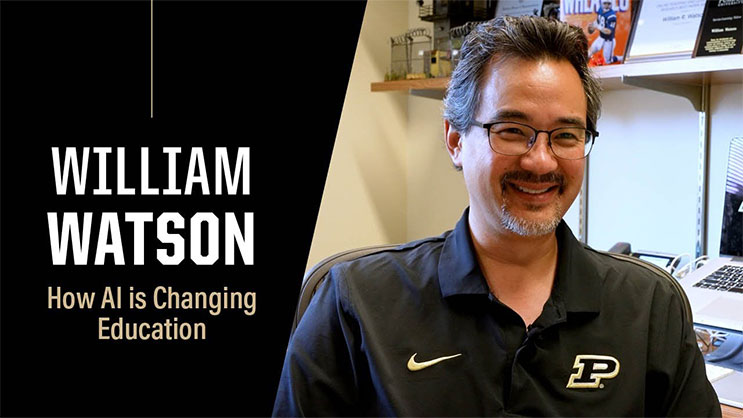
- AI in Education: Bill Watson – “Education in the (dis)Information Age” https://youtu.be/XHG_loMH1-A
- DiCerbo, Kristen; Wright, Wayne, et. al. (2024, April 19). AI-ED Fusion: Symposium on STEM Education in the Age of AI. Purdue University. https://youtu.be/2Cg8AJeVnsc
- Grant, Melva; Kastberg, Signe; et al. (2024, April 5). Power Friday: Emerging Educational Technologies – Enhancing Learning with VR, XR, & AI [Presentation]. Power Friday, Purdue University. https://youtu.be/pnI9DuhsRSA
- Cheng, Y. (2024, March 28). How Early, Accurate, and Fair Can We Predict Student Learning in Foundational STEM Courses? [Presentation]. Craft Data Science Insights: A 40-Minute Exploration, Purdue University. https://youtu.be/T1xH3S_PAFo
- Zhang, S. (2024, March 26). Exploring the NAEP Math Achievement Gap: Insights from Test-Taking Process Data [Presentation]. Craft Data Science Insights: A 40-Minute Exploration, Purdue University. https://youtu.be/_zSWlyBsuQ8
- Zheng, C. (2024, March 20). Psychometrics Empowering Large Language Models in Chinese Essay Automated Scoring [Presentation]. Craft Data Science Insights: A 40-Minute Exploration, Purdue University. https://youtu.be/2AmBLN0C5m8?si=R-RS7KCa59HrY1O-
- He, Q. (2024, February 26). Sequence Mining on Process Data in Digital-Based Large-Scale Assessments [Presentation]. Craft Data Science Insights: A 40-Minute Exploration, Purdue University. https://www.youtube.com/watch?v=9Dl1ewGxTRA
- Kwon, K. (2023, September 15). AI Education: Lessons Learned for Empowering Teachers and Enriching Student Learning [Presentation]. Power Friday, Purdue University. https://youtu.be/5MUmoVgbbB0
Huang, W., & Yu, W. (2024, April 14). Top-down vs. Grassroot: A comparative study on AI integration barriers in K-12 in South Korea and the United States [Conference presentation]. 2024 American Educational Research Association (AERA) Annual Meeting, Philadelphia, PA, United States. https://www.aera.net/
Yu, W., & Huang, W. (2024, April 11). AI is no more a magic box: A case study of an AI educational program [Conference presentation]. 2024 American Educational Research Association (AERA) Annual Meeting, Philadelphia, PA, United States. https://www.aera.net/
Sirnoorkar, A. (2024, February). Leveraging Generative-AI in physics education. Physics Education Research group seminar, Department of Physics and Astronomy, Purdue University.
Jiang, Y., Xie, L., Lin, G., & Mo, F. Widening the Debate: The Academic Community’s Perception of ChatGPT. 2024 American Educational Research Association (AERA) Conference. Philadelphia, PA.
Yu, W., Kang, S., & Huang, W. (2023, December 1). C.A.R.E (computer science, artificial intelligence, robotics, and emerging technologies) @ Purdue [Conference presentation]. Trustworthy AI Lab for Education Summit, Notre Dame, IN, United States. https://lucyinstitute.nd.edu/trustworthy-ai-lab-for-education-summit/
Jiang, Y. (2023, December 1). Exploring ChatGPT: Policy and Regulation of Digital Frameworks Through Twitter Discourse [Conference presentation]. Trustworthy AI Lab for Education Summit, Notre Dame, IN, United States. https://lucyinstitute.nd.edu/trustworthy-ai-lab-for-education-summit/
Huang, W., & Yu, W. (2023, December 1). Artificial intelligence (AI) and education – voices from K-12 educators in South Korea and the United States [Conference presentation]. Trustworthy AI Lab for Education Summit, Notre Dame, IN, United States. https://lucyinstitute.nd.edu/trustworthy-ai-lab-for-education-summit/
Chang, H. (2023, December 1). Integrating Psychometric Tools into AI Development [Panel Presentation]. Trustworthy AI Lab for Education Summit. https://www.youtube.com/watch?v=Lj3ZX1GIW1o&list=PL-8_PytklE-NbIgVRNqPXdeMlfsbV9PDE&index=2
Sirnoorkar, A., Laverty, J.T., Zollman, D., Rebello, S. & Bryan, L.A. (2023, December). Exploring student and AI generated assumptions to varying degree of promoting. Proceedings, International Conference on Physics Education (ICPE), India.
Huang, W. & Yu, W. (2023, November 10). The collaboration between AI and educators. Indiana Association of Colleges for Teacher Education (IACTE) webinar. https://www.inaacte.org/
Huang, W., & Yu, W. (2023, October 15-19). AI education integration in South Korea from early adopter’s perspectives: A case study [Conference presentation]. AECT 2023 Convention, Orlando, FL, United States. https://convention.aect.org/
Chang, H. (2023, October 4). Building Adaptive Testing Tools to Improve Classroom Assessment in Large Introductory STEM [Presentation]. Center for Astrophysics, Harvard & Smithsonian Science Education, CfA Science Education Department, Harvard University. https://www.youtube.com/watch?v=gCmfTv3fNuE
Sirnoorkar, A. (2023, October). Development and analysis of assessments that promote sensemaking in physics. Physics Education Research group seminar, Department of Physics and Astronomy, Purdue University.
Yu, W. (2023, April 13-16). Investigating the barriers to introducing Artificial Intelligence (AI) education for elementary school teachers in South Korea [Conference presentation]. 2023 AERA Annual Meeting, Chicago, IL, United States. https://www.aera.net/Events-Meetings
Chang, H. (2022, June 15). A New Perspective of Computerized Adaptive Testing (CAT): From Testing to Personalized Learning [Presentation]. 2022 NCME Career Contribution Award Presentation. https://youtu.be/X15kcYkGUgA?si=0i7HT5GskpMfjMIM
Chang, H. (2018, April 14). From Adaptive Testing to Adaptive Learning [AERA E.F. Lindquist Award Lecture]. 2018 American Educational Research Association (AERA) Annual Meeting. New York, NY. https://youtu.be/1jZv3b5_-QE?si=58ztPGYTbBKWqXKi
Jiang, Y., Xie, L., Lin, G., & Mo, F. (2024). Widen the debate: What is the academic community’s perception on ChatGPT?. Education and Information Technologies, 1-20. https://doi.org/10.1007/s10639-024-12677-0
Xin, Y. P., Tzur, Si, L. Hord, C., Liu, J., Park, J. Y. (2017). An intelligent tutor-assisted math problem-solving intervention program for students with learning difficulties. Learning Disability Quarterly, 40(1), 4-16. doi:10.1177/0731948716648740
Cetintas, S., Si, L., Xin, Y. P., & Tzur, R. (2013, October). Probabilistic latent class models for predicting student performance. In Proceedings of the 22nd ACM international conference on Conference on information & knowledge management (pp. 1513-1516). ACM
Cetintas, S, Si, L., Xin, Y. P., Zhang, D., Park, J. Y. & Tzur, R. (2010). A Joint Probabilistic Classification Model of Relevant and Irrelevant Sentences in Mathematical Word Problems. Journal of Educational Data Mining, 2(1), 83-101.
Cetintas, S., Si, L., Xin, Y. P., and Hord, C. (2010). Automatic Detection of Off-Task Behaviors in Intelligent Tutoring Systems with Machine Learning Techniques. IEEE Transactions on Learning Technologies, 3( 3), 228-236.
Cetintas, S., Si, L., Xin, Y. P., Hord, C. (2010). Predicting Correctness of Problem Solving in ITS with a Temporal Collaborative Filtering Approach. In Vincent Aleven, Judy Kay, Jack Mostow, editors, Intelligent Tutoring Systems, 10th International Conference, ITS 2010, Pittsburgh, PA, USA, Proceedings, Part I. Volume 6094 of Lecture Notes in Computer Science, pages 15-24, Springer.
Cetintas, S., Si, L., Xin, Y. P. and Hord, C. (2009). Predicting correctness of problem solving from low-level log data in intelligent tutoring systems. In Proceedings of the 2nd International Conference on Educational Data Mining (EDM)
Cetintas, S., Si, L., Xin, Y. P., Hord, C. & Zhang, D. (2009). Learning to identify students’ off-task behavior in intelligent tutoring systems. In V. Dimitrova, R. Mizoguchi, B. du Boulay, A. Graesser (Eds.), Proceedings of the 14th International Conference on Artificial Intelligence in Education (pp. 701-¬703). Amsterdam, Netherlands: IOS Press.
Cetintas, S., Si, Luo., Xin, Y. P., Zhang, D., Park, J. (2009). Automatic text classification of mathematical word problems. In Proceedings of the 22nd International FLAIRS Conference (pp. 27-32). AAAI Press.
Ozen, Z. (2024). Developing a first-level gifted identification tool: A machine learning application. Dissertation Chair: Nielsen Pereira
Karakis, N. (2021). Predictors of early postsecondary stem persistence of high-achieving students: an explanatory study using machine learning techniques. Dissertation Chair: Nielsen Pereira