“Empowerment”: Over 300 attend 2nd annual Purdue AI in P-12 Education conference

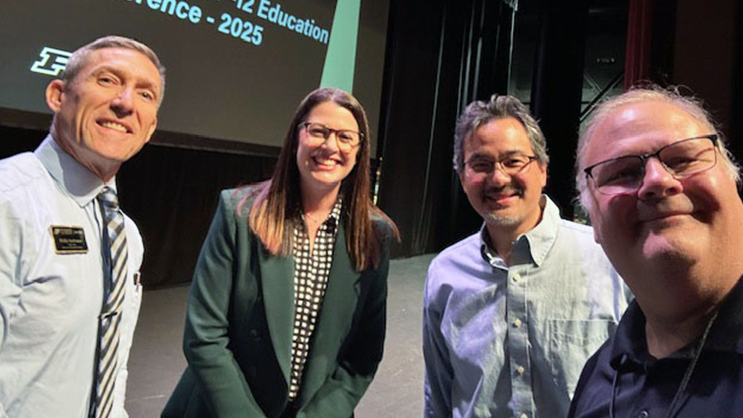
(2nd from left) Prof. Hua Hua Chang with Education graduate students (Photo provided)
The College of Education hosted the 2nd annual Purdue AI in P-12 Education Conference, “Empowerment,” on Nov. 10, 2025, at Purdue University.
Over 300 participants, including P-12 teachers, principals, superintendents and staff, attended the conference, which focused on how AI can be leveraged to empower educational stakeholders, particularly teachers and their students. Presentations included resources and strategies to promote student learning and further teacher development, with over 50 presentations on AI for curriculum development, school AI policy, bias, privacy and AI, and AI and education research; networking with AI vendors; and Professional Growth Points for teachers.
AI is a key focus of Purdue Computes, a strategic Purdue University initiative to further scale Purdue’s research and educational excellence.
The conference is a part of the College of Education’s Artificial Intelligence/Data Science Initiative. William (Bill) Watson, the creator and organizer of the conference, heads the College’s Artificial Intelligence/Data Science Initiative (part of Purdue’s Strategic Initiative Purdue Computes), directs the Purdue Center for Serious Games and Learning in Virtual Environments, and is a professor in the Department of Curriculum and Instruction’s Learning Design and Technology Program.
“I chose ‘empowerment’ as this year’s theme because I wanted to highlight the positive notion of what AI can mean for education at large and teachers and administrators in general,” said Watson. “The idea of empowerment is gaining power, control, and confidence – in particular with oneself.”
Watson believes that when utilized in a thoughtful and knowledgeable way, AI can equip teachers with the means to offload some of the workload that they are required to do but that takes time away from their passion and impact of being guides, motivators, and coaches of their students.
“AI can improve the efficiency of work related to administration, instructional design, giving teachers more time to focus on engaging with their students and refilling their own buckets,” he said. “Likewise, it can support administrators and staff in understanding and implementing data to guide better decision making and strategic planning.”
The conference started with a welcome from Phillip J. VanFossen, interim dean of the College.
“It is our sincere hope that, no matter where you are in your AI in education journey, your experiences today will help you address one or more of these important AI issues,” VanFossen said.
“We are excited to share our research with teachers and others, but also to learn from our teacher colleagues on the ground in the schools grappling daily with the both the prospects and the challenges of AI in education,” said Wayne E. Wright, associate dean for research, graduate programs, and faculty development.
The conference came about because Watson, VanFossen, and Wright felt that the College’s expertise could provide important professional development by offering a conference on the role of AI in P-12 schools – something everyone is scrambling to better understand.
“With this in mind, this year they invited Kate Maxwell, interim CEO of TechPoint Youth, to give the conference keynote. Maxwell is an accomplished engineering, technology, and industry leader with more than 20 years of experience supporting public sector customers around the globe.”
“I am so excited to explore how we can harness AI responsibly to drive student outcomes,” said Maxwell. “We will explore ways to balance innovation with responsibility, with the ultimate goal of preparing the next generation for a workplace and world transformed by AI.”
“Kate utilized her expertise and experience as a leader of global support at Microsoft and elsewhere, and her current role leading a nonprofit focused on providing transformative STEM instruction to Indiana students to highlight specific data and use cases of how AI is being leveraged by educators around the globe,” Watson said.
He explained that Maxwell’s keynote, “Power, Perils and Promise of AI in P-12 Education,” gave a discussion that was thoughtful and clear-eyed as to what AI can mean for education – good or bad. “Her real-world examples showed exactly how learning outcomes could be impacted by effective integration, and her Q&A following the keynote kicked off the conference with a great dialogue with our attendees about moving forward in their specific journeys as P-12 educators.”
Watson is grateful for the collaboration of College of Education faculty and students who shared their expertise and research with utilizing AI and helped organize the conference. This included how to use a variety of specific AI tools as well as research on such topics as policy and AI for language learning among others.
Some examples include:
Generative AI: Enhanced Cognitive Design System Approach to Automatic Item Generation, by Jing Huang, doctoral student in Educational Studies
Mapping Empirical Evidence on Artificial Intelligence Tools for Mathematics Teachers: A Scoping Review, by Ghan Shyam Joshi, doctoral student in mathematics education, and Steven M. Heinold, director of school programs and associate director of Indiana GEAR UP (Gaining Early Awareness and Readiness for Undergraduate Programs)
Composing with AI: Conceptual Project-Based Lessons for 21st-Century Music Education, by Mitch Freeman, doctoral student in learning design and technology
This year’s sponsors also contributed to the success of the conference.
“We had 11 sponsors this year, which showed growth from last year, and we are looking to continue that growth moving forward,” Watson said. “Our top-level sponsors included Sibme, 220 Youth Leadership, Central Indiana Educational Service Center (CIESC), and Purdue Education’s Learning Design and Technology and Department of Curriculum and Instruction online programs, as well as the College’s Center for Advancing the Teaching and Learning of STEM (CATALYST). Our Level 2 sponsors were ColleagueAI and Purdue Online.”
Watson is enthusiastic about the growth of the 2025 conference from its successful inaugural offering in 2024, and attributes it to the keynote speakers, resources such as the College’s AI in Education YouTube videos, sponsors, and the support of the College of Education and Purdue. He looks forward to continuing to grow AI use at Purdue and in the field of education.
“While some see AI in education primarily through the lens of a threat, it has great potential to empower all stakeholders in the learning process to take better control and lead that process – including students,” he said.
According to Watson, the conference is growing, with nearly double the number of presentation proposals this year and almost 25 percent more attendees. He heard a lot of dialogue and discussion between attendees, which is exactly what he and the organizers hoped for, and he wants the conference to widely impact education in Indiana and beyond.
“The conference is meant to be a place to bring everyone together to help each other tackle this huge challenge that we are all suddenly facing and that shifts and changes constantly,” Watson said. “I think the conference did a great job of meeting that need, and I saw a lot of excitement and sharing amongst the attendees.”
Source: Bill Watson
About the College of Education’s AI/Data Science Initiative
The College of Education is actively engaged in Purdue University’s Strategic Initiatives surrounding Artificial Intelligence (AI) and Data Science. The College’s AI Working Group guides and coordinates the College’s current and future efforts in these quickly evolving areas.
Read about the inaugural 2024 Purdue AI in P-12 Education conference