AI in P-12 Education conference: Educators come together to discuss ‘disruptive’ AI
Using AI to improve student learning

(l to r) Dean Phillip J. VanFossen, Keynote Speaker Kui Xie, and conference organizer Bill Watson (Purdue College of Education photos/DeEtte Starr)
The College of Education hosted the 3rd annual Purdue AI in P-12 Education conference, “Coherence,” at Purdue University (Nov. 2).
AI is a key focus of Purdue Computes, a strategic Purdue University initiative to further scale Purdue’s research and educational excellence.
The conference is a part of the College of Education’s Artificial Intelligence/Data Science Initiative. William (Bill) Watson, the creator and organizer of the conference, heads the initiative, directs the Purdue Center for Serious Games and Learning in Virtual Environments, and is a professor in the Department of Curriculum and Instruction’s Learning Design and Technology Program.
The attendees included Seoul National University faculty member Cheolil Lim and seven of his graduate students, who gave three presentations; and P-12 teachers, principals, superintendents, and staff. There were 35 presentations (including 11 research presentations) from teachers, Purdue faculty and students, technology consultants, principals, and others. Attendees could choose between several conference tracks, including AI Education Research, AI Tools for Teachers and Students, AI Curriculum Applications, and AI Ethics and Policy.
The inaugural conference occured in 2024 when Watson; Phillip J. VanFossen, the Suzi and Dale Gallagher Dean of Education; and Wayne E. Wright, associate dean for research, graduate programs, and faculty development; saw that the College’s expertise could provide important educator professional development by offering a conference on the role of AI in P-12 schools – something educators are scrambling to better understand.
Watson said that he chose “Coherence” as this year’s theme because there’s a lot of “chaos” within the world of AI in P-12 and higher education and he wanted to promote discussion to help educators know how to respond to and better use AI as a tool in education.
The conference started with a welcome from Dean VanFossen, who said that AI holds the capacity to solve massive global issues but that it also poses a huge risk if deployed without safety alignment.
“This duality frames AI as potentially the most powerful tool humanity has ever created,” VanFossen said. “Perhaps one of the reasons you are here today is that you are wrestling with similar issues related to AI use. I hope your experiences today will help you better address these important issues.”
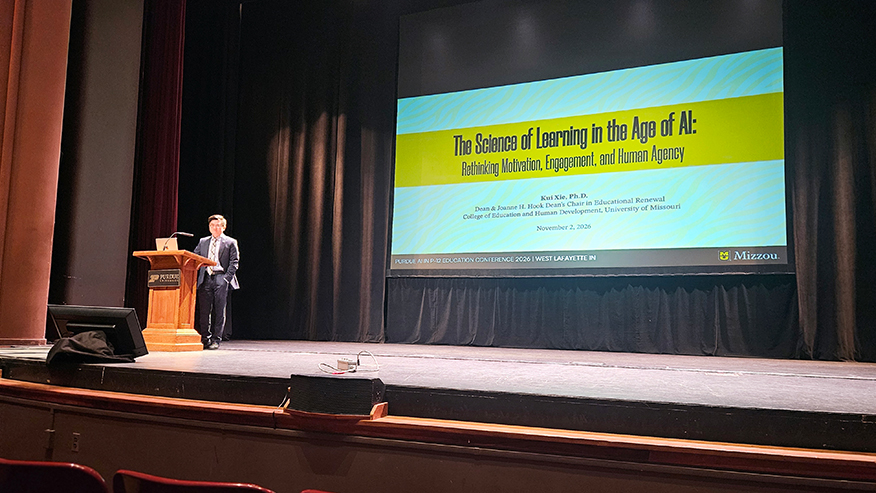
Keynote speaker Kui Xie, the Dean and Joanne H. Hook Dean’s Chair in Educational Renewal in the University of Missouri’s College of Education and Human Development, spoke on “The Science of Learning in the Age of AI: Rethinking Motivation, Engagement, and Human Agency.”
Xie is known for his extensive research and leadership in digital learning motivation, K-12 technology integration, and learning analytics. He maintained that the question should not be “Should we use AI?” or “How can we stop students from using AI to cheat?” but rather “How can teachers and AI work together to improve teaching and learning for students?”
Xie said that teachers won’t be replaced but should evolve in using AI to improve student learning. He asked four main questions:
- What motivates students to use AI differently?
- Why do students cheat with AI?
- Will AI replace teachers?
- How should teachers evolve to use AI effectively in learning?
Xie stated that AI will never replace teachers because of the social relationships teachers offer their students.
Francine Denecke, assistant principal of Harrison High School and recent PhD alumna of the College of Education, gave a breakout session titled, “Examining the Utility of Indiana School Districts’ AI Policies: A Qualitative Document Analysis.” She noted that less than half of Indiana school systems had a published AI policy last year, and of those that did, the vast majority had purchased a boilerplate policy from the same vendor that largely did not incorporate considerations of student concerns.
Some of the other breakout sessions included:
- “Making Sense of AI: District Leaders’ Perspectives on Organizational Change, Policy, and Practice” – Lamonica Williams, Clinical Assistant Professor; and Victoria Lowell, Clinical Professor; both of the Purdue University College of Education
- “Teaching Teachers When Not to Use the Tool” – Ryan Murray, Professional Learning Specialist, CIESC/Keep Indiana Learning
- “For All A Chance to Engineer with AI and Robotics: facelab-air.org” – Morgan Hynes, Research and Youth Programs Lead, SCALE K-12, Purdue University
- “Beyond Easy A’s: Leveraging AI to Increase Instructional Rigor” – Danielle White, School Development Director, The Excel Center National Office
- “Teacher Centered AI for Language Teaching and Assessment” – Virak Chan and Wayne E. Wright, Purdue University College of Education
“While I appreciated the chance to present my own research, I especially enjoyed the unique opportunity to interact with local Indiana teachers, researchers, and industry representatives to discuss and explore these important topics surrounding AI and education,” said Wright.
He added that the sessions he attended showed him how a local high school teacher integrates AI into English classes, how a Purdue instructor is preparing future math teachers to use AI, and how South Korean scholars are implementing a comprehensive national AI professional development program and certifications for its K-12 teachers. He also saw firsthand how Lego Education’s K-12 curriculum integrates robotics, coding, and AI.

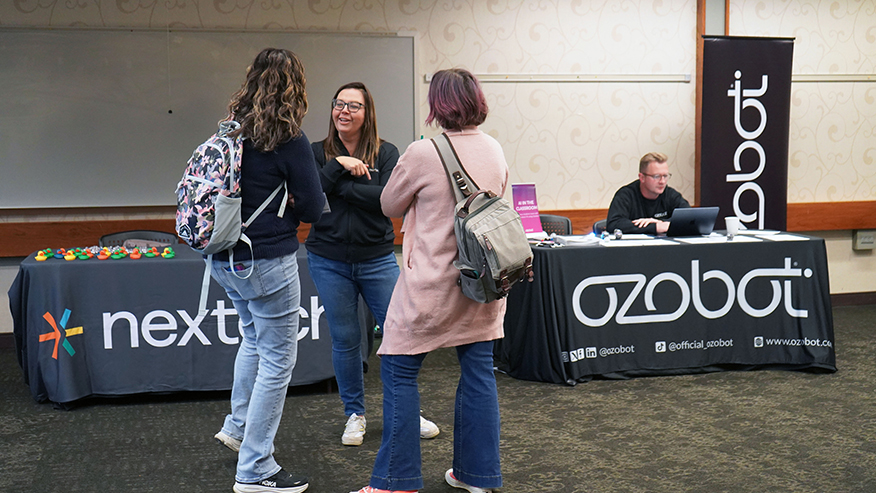
This year’s conference sponsors included CATALYST, LEGO Education, Eduba, Nextech, Ozobot, and Purdue’s SCALE K-12 initiative; and the College of Education’s Department of Curriculum and Instruction, Learning Design and Technology Program, Online Programs, and Education Engagement Board.
CATALYST shares a focus on AI with the conference, where CATALYST’s Bill Walker and Paul Asunda presented “Thought Partner or Answer Machine? Helping Students Learn the Difference.” The hands-on session had participants build criteria for distinguishing AI that supports thinking from AI that replaces it, and explored how the AI Assessment Scale can clarify expectations for K-12 students.
Watson is grateful for the collaboration of College of Education faculty and students who helped organize the conference and shared their expertise and research in utilizing AI, including using a variety of specific AI tools and researching such topics as policy and AI for language learning.
“What stood out to me while helping organize this year’s conference was how broad and engaged the community was,” said Siying (Belle) Li, a Ross-Lynn Postdoctoral Research Scholar in AI in Education in the College’s Department of Curriculum and Instruction. “We had students, educators, and researchers from Greater Lafayette, Chicago, and schools and universities well beyond the Purdue area. People came ready to share their work and learn from one another.”
“Because the conference focuses specifically on AI in P–12 education, the conversations were practical and directly relevant to educators’ work,” Li said. “It was especially rewarding to see those connections continue afterward as attendees shared their projects, session takeaways, and reflections on the keynote across social media.”
Watson said he was very proud of the conference the College has put on for the past three years.
“I think we can point to outstanding keynote presentations each year, and I really think the quality of our presentations have grown each year,” Watson said. “AI is disruptive and everyone is still very much trying to get a hold of how to handle this new reality. I think the conference once again was a wonderful chance for all of us to take a breath and come together to talk and share experiences in moving towards stronger learning for our children and better support for our educators who remain vital to the health of our state and society.”
“The College is proud to support the only AI in P-12 education conference in Indiana, because there is no more timely topic in P-12 education or in the preparation of teachers than the use of artificial intelligence,” said VanFossen. “Given Purdue’s prominence in AI, and the College’s role in AI at Purdue, this is a perfect opportunity for us to engage our school-based partners in conversations about AI use, AI policy, and the future of teaching and learning.”
Source: Bill Watson
More:
2026 keynote video
2025 Purdue AI in P-12 Education conference
Inaugural 2024 Purdue AI in P-12 Education conference
About the College of Education’s AI/Data Science Initiative
The Purdue University College of Education has a history of service and engagement within the P-12 community and beyond. Its faculty scholars, centers, and funded grant projects engage in interdisciplinary research to leverage AI tools and to collect and analyze data that seeks to transform learning and teaching, inform policy, and impacts the lives of culturally and linguistically diverse students, families and communities.