Small steps to #GiantLeaps: Web team serves College, Purdue and beyond
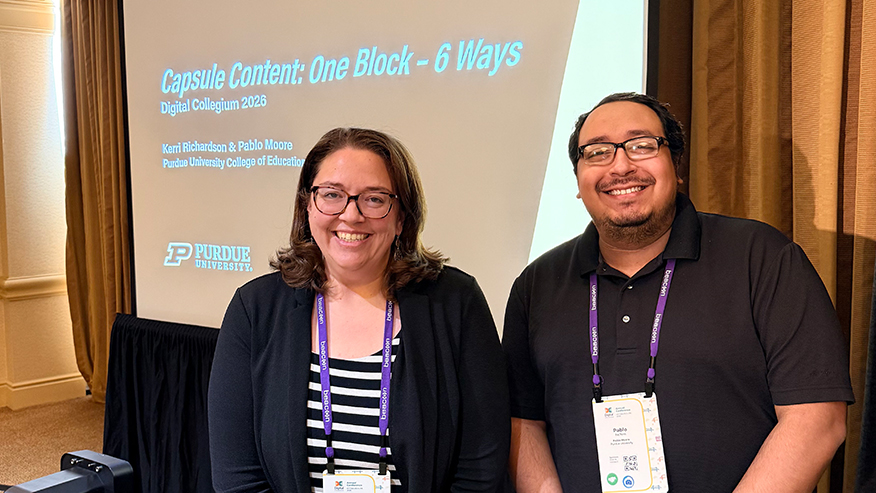
College of Education web development team (l to r): Kerri Richardson, web developer, and Pablo Moore, associate web designer
In the past four months, the College of Education’s talented web development team shared their knowledge in web development and digital accessibility nationally at three higher education web conferences.
Kerri Richardson, web developer, and Pablo Moore, associate web designer, recently gave three presentations at national virtual and in-person conferences:
- “Just Say No…to PDFs” virtually at the 2026 Digital Collegium Accessibility Summit (July 28, 2026) and the WPCampus Virtual Summit: Leading on Accessibility in Higher Education (September 17, 2026)
- “Capsule Content: One Block, Six Ways” in person at the 2026 Digital Collegium Annual Conference (October 18-21, 2026, Pittsburgh, Penn.)
The two honed their expertise in these topics through a year-long conversion of the College of Education’s website in 2024-25 – the first full WordPress-to-WordPress conversion to Purdue’s current web theme. They realized that the lessons they were learning during the process would be useful to Purdue web developers and beyond.
At Purdue, they shared their experience and knowledge by working closely with colleagues at Purdue Information Technology and Purdue Brand Studio, and by helping College of Education faculty and staff understand the necessary website changes and best practices. Along the way, they continued to improve their own skill sets by attending several higher education web development conferences.
Moore and Richardson began to see that what they were doing with the College of Education website could benefit Purdue and others.
“We were inspired to present on ‘Just Say No…to PDFs’ after attending last year’s Digital Collegium annual conference,” Moore said. “When we told other attendees that we don’t allow PDFs on the College of Education website, they were surprised and shocked that we managed to pull that off. This inspired Kerri and I to submit a presentation proposal on that topic.”
Most people don’t realize that PDFs create multiple accessibility problems for websites. In their presentation, Moore and Richardson discussed those issues and presented practical solutions for attendees who wanted to remove PDFs from their own sites.
“Saying ‘no’ to PDFs is not without its challenges,” said Richardson. “Our goal was for attendees to walk away with knowledge they could put into action.”
Presentation attendees received downloadable samples of the College of Education team’s templates and tools the team used during the PDF removal process.
“Half the battle sometimes is coming up with the right tool to start a project,” Richardson said. “We didn’t want people to start with a blank slate when we had already created something that could help.”
During the College website conversion process, Moore and Richardson began experimenting and pushing the limits of the theme’s content blocks, coming up with creative solutions while maintaining best practices and accessibility.
“That’s how our ‘Capsule Content: One Block, Six Ways’ presentation came about – we kept finding new ways to use a block called the ‘post archive grid,’” Richardson said. “The block was originally designed to be used for ‘news and events,’ but we realized it could also work for other kinds of content – like our Program Finder. We wanted our presentation to show that you don’t have to always use a block as originally intended.”
“It’s one of our highest performing blocks,” said Moore. “The pages it’s on see some of the highest engagement across our whole site. We decided to create a presentation that encouraged attendees to think creatively and find their own pieces of reusable content.” The post archive grid block is a content block in Purdue’s web theme that allows for an array of posts or pages to be displayed on a page in a grid. The block can be configured to add filtering and search, making content easy to find. [See the post archive grid on the College’s Program Finder and Directory, among other pages.]
Richardson and Moore shared responsibility for developing the presentations. Richardson bookended the presentations with more of the history/background, governance, and planning/research of their projects, while Moore focused on accessibility, practical implementation, case studies, and technical examples.
From their first and second presentations of “Just Say No…to PDFs” – attended by over 120 people – Richardson and Moore saw that attendees really liked the case study format they used.
“This format organizes examples into background, problem, and solution, which allowed us to paint a full picture for our audience,” Moore said. “We received such good feedback from our first presentation that we decided to recycle this format for our ‘Capsule Content’ presentation.”
Feedback for the two “Just Say No…to PDFs” presentations was overwhelmingly positive. Attendees saw examples of navigating rigid attitudes about continuing to use PDFs on websites, and learned how to discuss needed changes with stakeholders, find solutions, and deal with the solutions’ reception.
For the third presentation, “Capsule Content: One Block, Six Ways,” the pair received additional positive feedback. Attendees appreciated hearing about the team’s discussion with Purdue peers and how their solutions are still benefiting other Purdue units who are navigating similar web development challenges.
Richardson and Moore’s knowledge in these areas really grew during the earlier College website conversion project. Besides discussing and sharing knowledge with Purdue IT and Purdue Brand Studio, they have supported the College by working one-on-one with faculty and other website stakeholders. One way they did this was to hold an Accessibility Town Hall in February 2026, before the three conference presentations.
“We presented to College of Education faculty and staff on the upcoming Department of Justice accessibility ruling and answered some of their frequently asked questions,” Moore said. “This ended up being great practice for both of us to prepare for these other presentations.”
They plan to hold a second Town Hall on November 20, discussing accessibility and partnering with Purdue Innovative Learning to do a live demo of its YuJa Panorama tool for the College’s faculty, staff, and graduate students.
Both Moore and Richardson have learned and grown through the process of distilling their knowledge into presentations to teach others.
“Presenting is an amazing experience! It really changes your perspective on how a presentation is actually structured and the work that goes into it,” Moore said. “I feel like I view other presentations from a different lens now that I know the ins and outs of creating a presentation.”
“Presenting at a professional conference has been a career goal of mine for several years,” Richardson said. “So it was extremely validating, career-wise, to know that the people in the room were eager to hear our knowledge and lessons learned. I can’t wait to do it again!”
Moore and Richardson continue to regularly put their expertise into action. Moore recently provided accessibility recommendations to Purdue Brand Studio, which were adopted into the web theme university-wide, and Richardson was asked to serve on a team of university web developers drafting web governance for a project with Purdue IT.
“Kerri and Pablo clearly demonstrate why you don’t need a large team to make a difference,” said Phillip J. VanFossen, the Suzi & Dale Gallagher Dean of Education. “Their contributions are being recognized not only at the university level, but nationally. The College may be small relative to others at Purdue, but Kerri and Pablo’s efforts prove we can, and do, lead the way in many areas.”
What are some future “small steps” for these two?
“We will definitely be submitting a few more proposals for next year’s annual conference!” Moore said. “We have plenty of ideas that we’d love to present on.”
Sources: Pablo Moore & Kerri Richardson