CATALYST accepts eight new research fellows
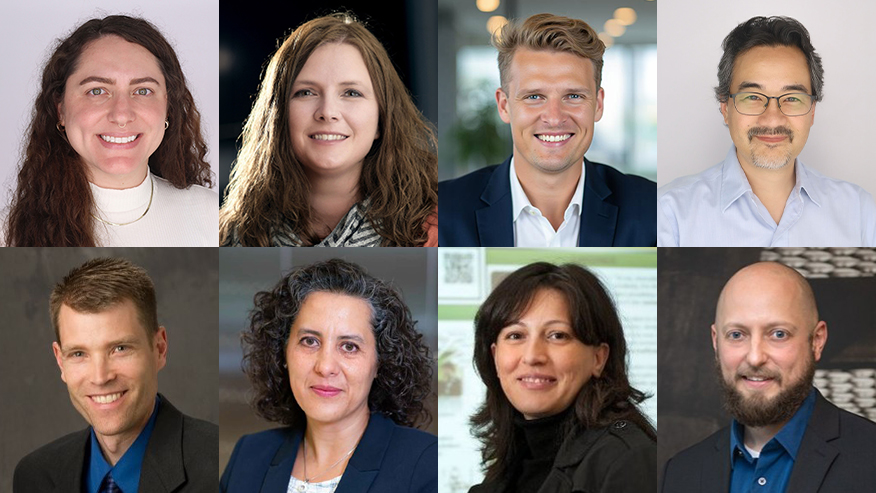
(Top, l to r) Danielle Malone, Rebekah Hammack, Isaiah Kent-Schneider; William Watson ; (bottom, l to r) Todd Kelley, Alejandra Magana, Senay Purzer, Greg Strimel
A Purdue University hub for K-12 STEM Education research and services, the Center for Advancing the Teaching and Learning of STEM (CATALYST) named eight new research fellows from across Purdue University to expand its research collaboration.
“We’ve recruited eight new members across the college/university who are eager to partner with CATALYST on K-12 STEM education research,” said Paul Asunda, executive director of CATALYST and an associate professor of engineering and technology teacher education in the College of Education.
CATALYST does collaborative STEM education research through its CATALYST fellows. CATALYST’s best-known program is its annual Indiana STEM Education Conference, which will take place on January 14, 2027, at Purdue – for the twelfth time.
“Building on more than 10 years of groundbreaking research and high-quality STEM education programming, CATALYST is entering an exciting new phase,” Asunda said. “As Purdue’s hub for STEM education excellence, we’re eager to grow our partnerships and collaborations across campus and around Indiana.”
When Alejandra Magana, professor in the School of Applied and Creative Computing and the School of Engineering Education in the College of Engineering, received an invitation to join the CATALYST Fellow program, she immediately wanted to be part of the opportunity.
“I see myself contributing to interdisciplinary, theoretically grounded research that advances knowledge in STEM teaching and learning, often enabled by technology, and that makes immediate practical contributions to addressing educational challenges and needs,” Magana said. “I was also very excited to connect or reconnect with other fellows who have made outstanding contributions to STEM education.”
Asunda accepted a total of eight new Purdue faculty members as research fellows. Four are faculty members in the College of Education:
- Danielle Malone, assistant professor of science education and the program coordinator for the College’s Secondary Science Education program
- Rebekah Hammack, associate professor, science education
- Isaiah Kent-Schneider, clinical assistant professor of science education
- William R. Watson, professor of learning design and technology, director of the Purdue Center for Serious Games and Learning in Virtual Environments, and the chair of the College of Education’s Artificial Intelligence and Data Science Working Group
“One aspect of being a CATALYST Fellow that I am particularly looking forward to is having opportunities to step outside of my usual disciplinary spaces,” Malone said. “I see that as valuable for generating new questions, considering different approaches to my work, and thinking more broadly about where my research could go next.”
“I’ve personally seen the value of engaging students in the process of analyzing and designing solutions for authentic, culturally relevant issues in the classroom,” Kent-Schneider said. “When I found ways to do this, I saw student engagement, critical thinking, and learning increase. I want to be a part of helping teachers do the same.”
“My work looks at how learning can be engaging, interdisciplinary, and incorporate instruction targeting student attitudes as well as well-being,” Watson said. “That work can be as narrow as designing, implementing and evaluating specific instruction or as broad as envisioning new systems of education where learners direct the learning process and technology support teachers in focusing on teaching and facilitating student growth and passion for learning.”
The other four fellows are from other Purdue colleges with links to STEM education:
- Todd Kelley, professor in technology leadership and innovation, Purdue Polytechnic
- Alejandra J Magana, professor of engineering education, College of Engineering
- Senay Purzer, professor of engineering education, College of Engineering
- Greg Strimel, associate professor, School of Engineering Technology, Purdue Polytechnic
“My research has focused on improving teacher self-efficacy in teaching integrated STEM through multiple pedagogical approaches including co-teaching STEM, scientific inquiry and engineering design approaches, place-based education, and biomimicry,” Kelley said. “I enjoy collaborating with other colleagues to create innovation STEM education research to enhance education for teachers and their students.”
The original CATALYST Fellows were Paul Asunda, Selcen Guzey, Muhsin Menekse (no longer at Purdue), Sanjay Rebello, Minjung Ryu (no longer at Purdue), Hui-Hui Wang, and Lynn Bryan. Bryan was the original CATALYST executive director and retired from Purdue in 2024.
CATALYST has an extensive network of STEM educators throughout Indiana and from other states. Annually at the Indiana STEM Education Conference, over 600 Indiana and other teachers attend for professional development, networking, and improving their STEM education offerings to Indiana students – and more than 50 sponsors support the event.
“The success of our Indiana STEM Conference these past 11 years proves that not only do we offer high-quality events that meet the needs of today’s teachers, but that we know those teachers and they will attend!” said Bill Walker, associate director of CATALYST and organizer of the annual conference.
Besides the conference, CATALYST offers collaborative STEM education research and programming, with a STEM Education Colloquium Series twice per semester and its Design STEM Kids programs.
Prominent past projects include:
- Co-Robots to Enhance Motivation and Self-Efficacy in Formal STEM Education
Led by Nathan Mentzer, this project partners Indiana high school teachers with Purdue’s College of Engineering and Polytechnic Institute to bring human-interactive robotics into classrooms, broadening participation among underrepresented students and reaching more than 1,500 public-school students across Indiana and Georgia. - Integration of Engineering Design and Life Science
This initiative, led by Selcen Guzey with Lynn Bryan and Muhsin Menekse, developed engineering-design-based middle school curricula integrating life science and Next Generation Science Standards (NGSS) practices, reaching 35 teachers and more than 5,500 students across eleven partner schools. - STEM Teacher Scholarship Programs
From 2009 to 2025, CATALYST administered two externally funded scholarship programs, Project EINSTEIN (a Robert Noyce STEM Teaching Scholarship) and the 21st Century STEM Teachers Scholarship, supporting over 100 undergraduates pursuing careers in K-12 integrated STEM teaching.
“The future holds immense promise,” Asunda said. “Not only does CATALYST have the excellent reputation of Purdue University research, but we’re supported by the College of Education, the premier education training provider in the state of Indiana. We are Boilermaker Educators.”
“I am delighted with the direction CATALYST is heading—CATALYST 2.0, if you will,” said Phillip J. VanFossen, Suzi & Dale Gallagher Dean of the College of Education. “The new Fellows represent the best Purdue has in terms of addressing key issues in STEM education broadly, and K-12 STEM education in particular. CATALYST continues to be a point of pride for us in the College and for Purdue.”
Sources: Paul Asunda and Bill Walker
Upcoming CATALYST Events:
- Oct. 7, 2026 – CATALYST STEM Education Colloquium Series
- Jan. 14, 2027 – Indiana STEM Education Conference
More: Purdue CATALYST hosts Generational Advances through STEM Education
About CATALYST
The Center for Advancing the Teaching and Learning of STEM (CATALYST) is an interdisciplinary research center dedicated to advancing integrated STEM teaching and learning in formal and informal settings. Through collaborative research, educator preparation and professional development, partnerships, and evidence-based practice, we seek to strengthen integrated STEM education and inform local, national, and international educational practice and policy. I