Watson’s AI keynote explores ‘disruption’ needed to modernize learning systems
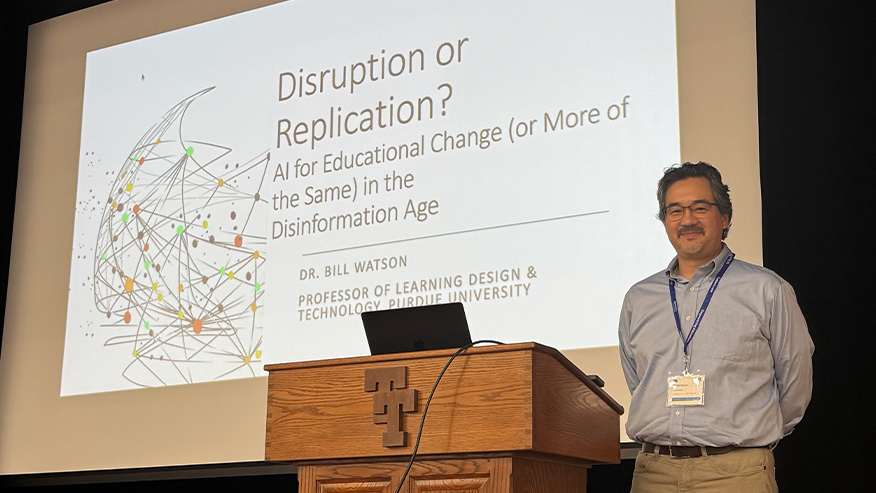
William R. Watson was invited to give the keynote at a recent AI conference for Indiana school administrators. The “Future Ready Schools: AI in Educational Leadership” summit was held at Taylor Community Schools in Kokomo, IN (July 20–21).
Watson, professor of learning design and technology and director of the Purdue Center for Serious Games and Learning in Virtual Environments, gave his keynote on “Disruption or Replication? AI for Educational Change (or More of the Same) in the Disinformation Age.” He was also featured on the summit’s panel of experts which discussed “Lessons from the Field.”
As the chair of the College of Education’s AI and Data Science Working Group and organizer of the annual Purdue AI in P-12 Education Conference (upcoming Nov. 2), Watson has been researching how to leverage technology for personalized and mastery-driven learning throughout his career. He teaches in the Purdue campus-wide online MS in Artificial Intelligence program and recently taught a new course, “Systems Thinking for AI-Driven Innovation and Change in Learning” which will be a part of the College’s AI in Education Graduate Certificate.
The Future Ready Schools summit was organized by recent College of Education alumna Melissa McIntire (PhD Educational Leadership & Policy Studies, ‘25), superintendent at Western Wayne Schools in Wayne County, IN.
“The Future Ready Schools Summit grew from a belief that educational leaders and educators must be prepared to engage thoughtfully with artificial intelligence as it continues to influence teaching, learning, leadership, and school operations,” said McIntire. “My doctoral work at Purdue strengthened my commitment to helping schools move beyond simply discussing AI and begin developing practical systems, policies, and strategies for responsible implementation. Dr. Bill Watson’s keynote presentation provided an important foundation for that work by challenging participants to think deeply about the role of AI in education and the responsibility we share in shaping how it is used.”
Watson explained that disruption can be viewed negatively or as an opportunity. “It is very clear that AI is the most disruptive influence on schools and learning that we have encountered in a very long time,” he said. “My presentation focused on the reality that the advent of generative AI calls for significant changes to the learning outcomes that we target as well as the assessments we use to evaluate learning.”
He explained that AI will be an immensely positive disruption to education if it is leveraged to transform systems of learning from outdated, calendar-driven and comparison-focused approaches that no longer meet learner or societal goals to a more forward-thinking approach.
“If AI is treated like most of our past educational technologies and is used to replicate rather than change our approach to learning, it will have severely negative impacts on learning,” Watson said. “But if it is used to drive a change to a focus on developing critical-thinking, creativity, and collaborative problem-solving through a personalized and learning-centric approach, then its disruption could be just what we have needed to finally modernize our systems of learning.”
Source: Bill Watson