Undergraduate Research Training Program
Undergraduates have the opportunity to gain invaluable research experience through the College of Education’s Undergraduate Research Training Program (URT).
Why Should I Apply to the URT Program?
- Participate in a small interdisciplinary program with 12-15 other undergraduate researchers who all share diverse interests in education research.
- Meet course requirements for a Learning Sciences in Educational Studies Minor – students earn 6 of the 18 credits needed.
- Work closely with an education faculty member and their research team.
- Engage in research experiences that build your curriculum vitae and prepare you for graduate school.
- Be supported as you develop your own research project throughout the academic year.
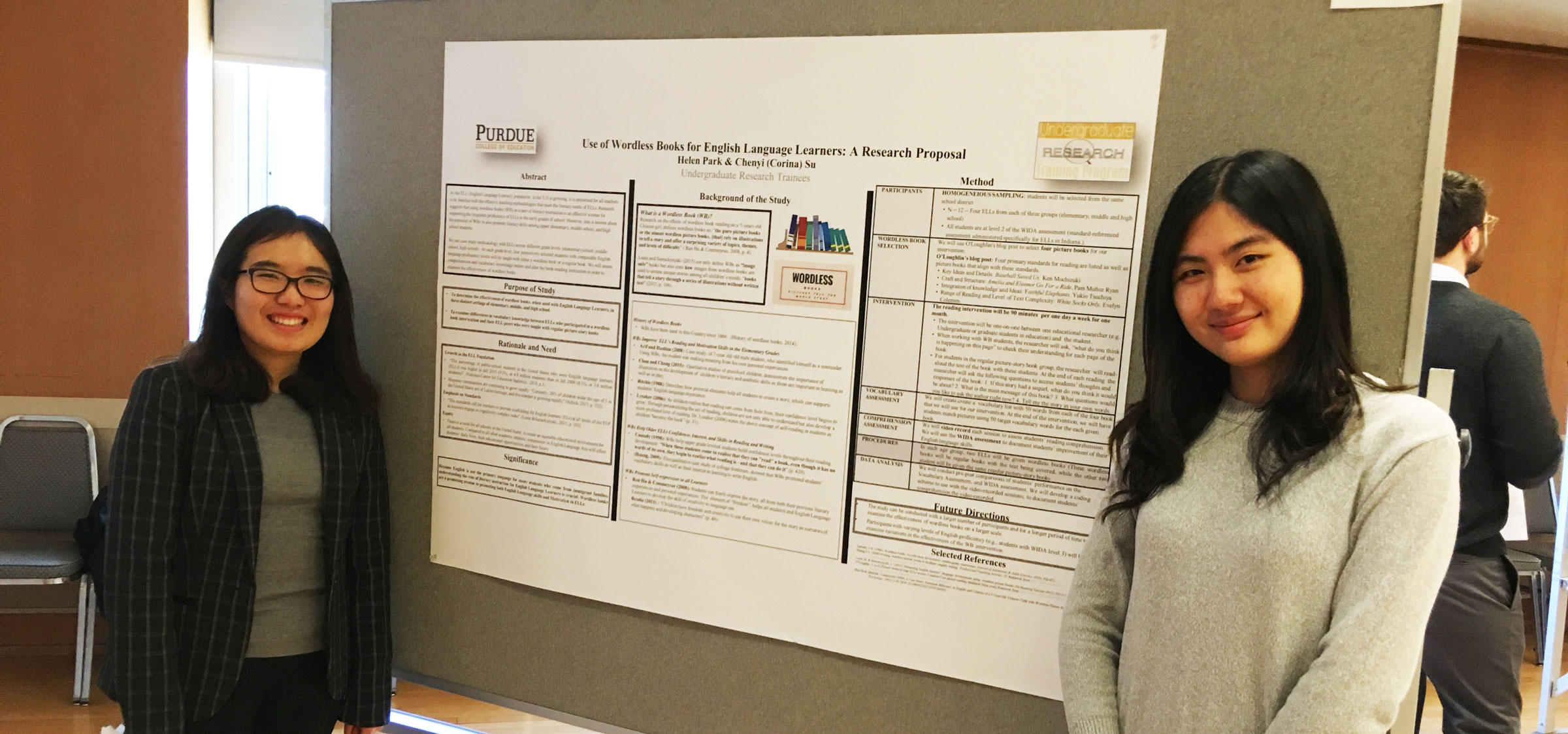
- Become an author! The URT program provides opportunities for your to develop and present your research during the academic year. Typical outlets include:
- Earn a stipend of ~ $1500/year
I really liked the pairing for the possible research team from the URT program as it provided me a chance to learn how research develops and the communication skills within a research group. Also, I think the program gave me a glimpse of what graduate school life is going to be like, and the methodology classes also gave me an idea of the type of research I would be more inclined towards. Overall, the opportunities I gained from this program were very beneficial and helped me a lot with my graduate school applications.
Jueqing Li
General Education Major
My undergrad research (URT) experience served me well. A formal academic benefit from my URT experience came when I was pursuing my doctorate at Northern Illinois University in the 1980s. I was able to draw from years of polling data for my dissertation titled, “The Attentive Public For Local school Politics.” My URT experience had a huge impact on my career in education.
Paul Leathem
HU ’68, MS ’70
Principal, Maine West High School, Des Plaines, IL (ret.)
Consultant, Illinois State Board of Education (ret.)
Examples of Previous Student Research Projects
- AI and Word Problems – Luke Braun, Mentor Dr. Laura Bofferding
- Beyond the School Day – Amanda Ibarra, Mentors Drs. Jasmine Begeske and Jennifer Smith
- Building Resilience: A Study of Trauma-Informed Support in AAU Preservice Teacher Programs – Joel Berringer, Mentor Dr. Ofelia Schepers
- Death Education at AAU Universities – Isyss Pranger, Mentor Dr. Heather Servaty-Seib
- Emotion Labeling to Children with ASD: A Systematic Literature Review – Jessica Wallace, Mentor Dr. Juliana Aguilar
- A Successful Day-1 with a VR Classroom Management Application – Philiip Godette, Mentor Dr. Wanju Huang
- Snapshots of the Preservice Teacher Experience – Aimee Zhang, Mentor Dr. Toni Rogat
- Examining the Effectiveness of an Undergraduate Oral Communication Class in Improving Interpersonal Communication Competence – Qiaoqiao Wang, Mentor Xiang Zhou
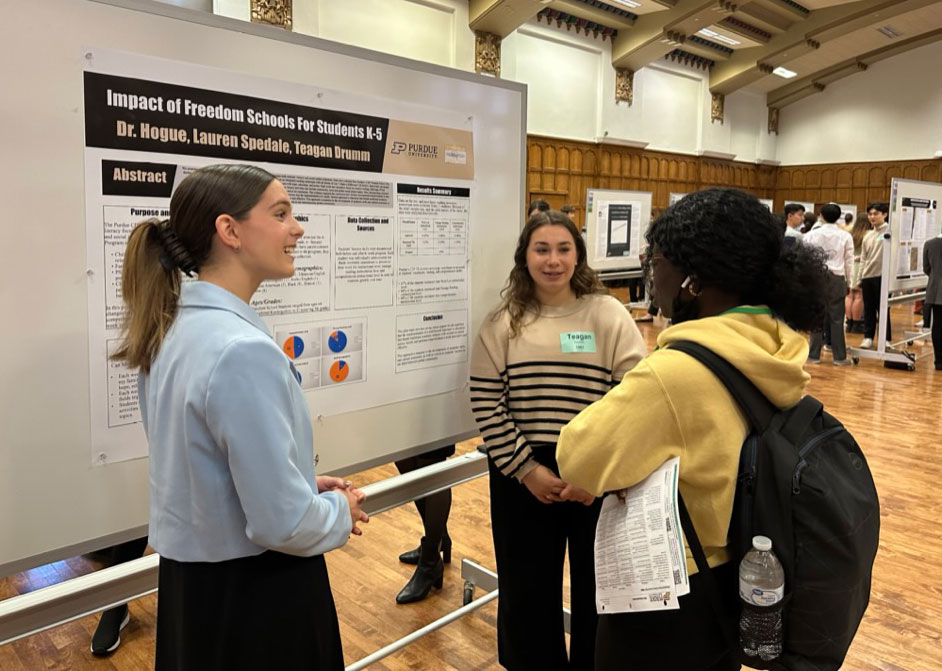
- Expanding Research Opportunities to Undergraduate & Graduate Students Through the Purdue CDF Freedom Schools Program Initiative in 2024 – Teagan Drumm, Mentor Breanya Hogue
- Language and Storytelling in Shape Composition – Lauren Spedale, Mentor Lauren Bofferding
- Teachers’ Motivation Regulation in Authentic Field Experiences – Anshi Shastry, Mentor Toni Rogat
- Poetry in the Classroom – Adeline Waltz, Mentor Mary Ellen Lennon
- Prepare to Teach Mathematical Model-based Problem Solving (MBPS) – Nicholas Cline, Mentor Yan Ping Xin
- Professional Development for Educators: Enhancing Instruction with Extended Reality (XR) Experiences for Enhanced Learning – Alexia Striebeck, Mentor Victorial Lowell
I have learned so much about the backbone of research methods. Also, we gained so many practical experiences within our research projects and from presenting our findings at conferences throughout the year. I would recommend this program to anyone wanting to strengthen their knowledge about research.
Addie Waltz
English Education
Frequently Asked Questions
The URT program uses an apprenticeship model to introduce and engage undergraduate students with educational research. It is intended for those interested in developing research knowledge and skills over two semesters through coursework and participation in a research practicum.
The program is available to ALL undergraduates with interests in education. Therefore, Participants in the program come from a variety of majors. These include:
- Education (e.g., elementary education, special education, social studies education, English education, mathematics education, science education, engineering education) as well as
- The social sciences (psychology, sociology, law and society, political science, anthropology)
- Human Development and Family Studies
- Speech Language, and Hearing Sciences
The URT program is two semesters long. It begins in the Fall and continues in the Spring.
Each year, the number of students selected for the program ranges from 12-15.
The URT program has two components:
- A research practicum experience that provides the opportunity for a URT to work alongside an education faculty member and his/her research team.
- A 2-semester course sequence in research methods. The courses in this sequence:
- Are reserved for the URT cohort.
- Are graduate level courses (EDPS 53300 in the fall and EDPS 53400 in the spring).
- Are taught on Wednesdays every week (5:30 – 7:30).
- Contribute 6 credits toward the 15-credit minor in the Learning Sciences in Educational Studies
Each academic year, during the first week of classes in the fall, a list of research projects for which URTs are eligible will be shared with students admitted to the URT program Previous Student Research Projects (above).
URTs are asked to indicate their top three choices and are then assigned to one of their top three choices.
The stipend for URTs for the academic year is $1,500.
Yes, in the context of the URT course sequence (EDPS 53300 and EDPS 53400), you will have the option to develop your own research project.
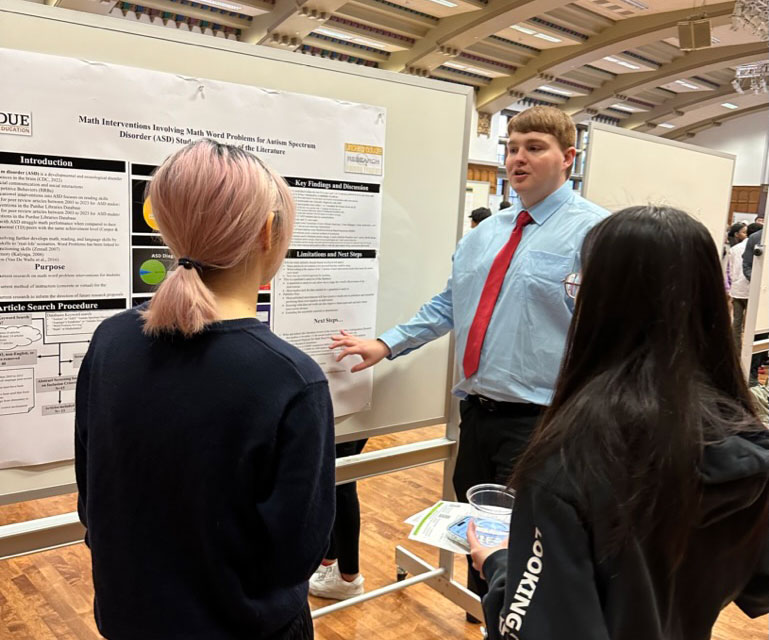
URT research is highly visible through presentations in the OUR Fall Expo, AGSERS, and OUR Spring Expo.
URT projects may be individual, collaborative (with another student), or part of the URT research practicum (in consultation with their faculty research mentor).
Support for the development of conference proposals and presentations (posters, research talks, virtual presentations) is provided in the context of the URT coursework.
Fall topics address the following:
- Ethical Issues in Research
- Overview of Quantitative, Qualitative, and Mixed Methods Designs
- Reviewing the literature and developing research questions
- Sampling in Quantitative and Qualitative Research
- Working with Descriptive Statistics
- Selecting and using Measures in Research
Spring topics are focused on Qualitative, Quantitative, and Mixed Methods approaches to research. Specifically, we address:
- Data analytic methods in quantitative studies
- Survey research methods
- Group Designs (Correlational, Causal Comparative, and Experimental)
- Single case designs
- Data analytic methods in Qualitative studies
- Qualitative research designs (case studies, narrative inquiry, ethnographic research)
- Mixed methods research designs, including action research and design-based research.
- Develop research skills, competencies, knowledge
- Understand what it means to work with a research team
- Understand the methods used to produce our knowledge on teaching and learning
- Work with professors who are leaders in their fields
- Course sequence contributes to Learning Sciences in Educational Studies Minor
- Strong preparation for graduate school and beyond