College of Education ABA faculty organizes critical strategic meetings in Colombia
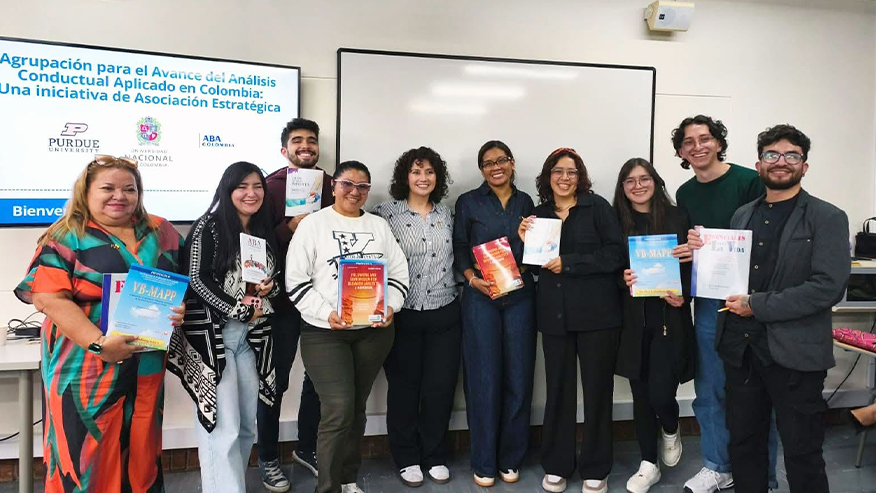
A Purdue College of Education faculty member is partnering with Colombian and other Latin American education organizations to meet a critical need for Applied Behavior Analysis (ABA) training, certification and support. ABA is a type of research-based therapy that seeks to aid those with autism and their families based on the science of learning and behavior.
Juliana Aguilar (BCBA-D), clinical assistant professor of special education in the College’s Department of Educational Studies, directs the College’s ABA program. Aguilar’s grant for this collaboration is titled “Innovation in ABA: Establishing the Field in Colombia through Strategic Development” and is funded by Purdue’s Global Impact Fund New Ideas Grant.
Partnering with the Nacional Universidad de Colombia, Aguilar recently organized two events to advance Applied Behavior Analysis in Bogotá, Colombia – a summit in April and a follow-up meeting in June. The April 2026 meeting was a unique initial effort to bring together academics and health care providers involved in the field of ABA across Colombia to engage in conversations about professional standards, infrastructure, and training aimed at ABA in Colombia.
To help address this need, Aguilar worked with Colombian partners to assess the current state of ABA in Colombia and to catalyze coordinated national efforts to strengthen the field through infrastructure development, professional standards, and international collaboration.
“This project is a wonderful example of the impact the College has—in this case, internationally,” said Phillip J. VanFossen, Suzi and Dale Gallagher Dean of the College of Education. “Dr. Aguilar’s expertise in ABA is extremely valuable because addressing autism has become a priority in other nations as well.”
Bilingual in Spanish and English, Aguilar partnered with ABA Colombia, an affiliate group with the Association of Behavior Analysis International and the Universidad Nacional de Colombia. Key local partners include Dr. Álvaro Arturo Clavijo, a professor with an emphasis in behavior analysis at the Universidad Nacional de Colombia, and Laura Suarez, president of ABA Colombia.
A total of 33 participants attended the April convening, representing healthcare provider facility Institucion Prestadora de Salud (IPS), providers and universities across Bogotá, Bucaramanga, Pasto, Barranquilla, Cartagena, Ibagué, Neiva, and Medellín.
“This convening occurred at a critical moment for the ABA field,” Aguilar said. “Following the suspension of the Board Certified Behavior Analyst® (BCBA®) credential outside the United States in 2022, countries across Latin America, including Colombia, have been left without a clear pathway to an internationally recognized certification. In response, new international certification bodies, including the International Behavior Analysis Organization (IBAO®) and the Qualified Applied Behavior Analysis Credentialing Board (QABA®), have emerged to fill this gap.”
She added that the need for national infrastructure is particularly urgent in Colombia because in 2015 it passed a national clinical protocol requiring services for individuals with autism that recommends ABA-based interventions.
“However, the protocol defines minimal requirements, 40–60 hours of training, and approximately 1,000 hours of supervised experience – without specifying competencies or evaluation mechanisms,” said Aguilar. “As a result, ABA services are currently funded through healthcare providers like IPS, but with variability in training quality and professional competency.”
Aguilar’s project goals are to assess national needs in ABA practice and training, explore certification pathways and professional standards, build academic-clinical partnerships, and lay the foundation for a national consortium.
Participants in the April meeting reached a consensus that ABA Colombia would serve as a central coordinating body. The meeting concluded with the designation of ABA Colombia as the Central Coordinating Body, development of a dual certification strategy (short-term certification through IBAO® and QABA®), a commitment from service providers like IPS, resource distribution, and defining the next collaboration milestones.
One of these milestones was to hold a follow-up meeting on June 10, 2026, where participants continued discussions on certification system development and decided upon key policy recommendations.
Some of the next steps include holding a strategic planning meeting with ABA Colombia to set timelines and priorities; launching a national data‑collection survey to document current professionals’ education, supervised hours, experience levels, and credentials; and hosting a public advocacy event with panels representing applied practice, basic science, parents, and healthcare providers.
By integrating local leadership with international expertise, these events created a clear roadmap for strengthening professional standards, expanding training opportunities, and developing a sustainable national infrastructure for ABA in Colombia.
The outcomes of this project position Colombia to become a regional leader in the development of culturally responsive, evidence-based behavior analytic services while contributing to global innovation in the field. Purdue’s expertise will aid special education and ABA intervention in Colombia.
“Efforts like the ones led by Dr. Aguilar’s are a testament to Purdue’s leadership in research and education while expanding its engagement mission in a new and critical area for Colombia as is ABA,” said Juan Diego Velásquez de Bedout, senior director of Purdue Global Partnerships.
MORE: The Purdue ABA program offers an ABA master’s, accelerated master’s, and online master’s.
Source: Juliana Aguilar