Reading Strategies for Parents and Teachers
Building the language foundation for reading
Kelsey E. Davison, Ph.D., Postdoctoral Researcher, Purdue University
Rebecca A. Marks, Ph.D., Assistant Professor, Purdue University
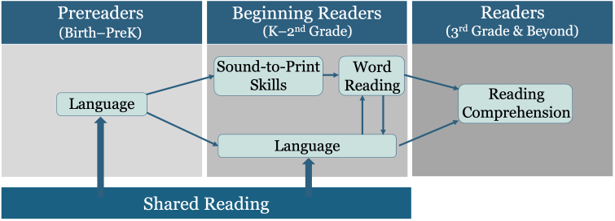
Adult-child shared reading interactions in both home and classroom settings expose young children to rich, complex language. Compared to everyday conversation, text in children’s books often includes a wider range of vocabulary, more complex sentences, and new ideas that may otherwise be encountered less frequently. Adults can also engage children in back-and-forth language interactions to discuss stories and connect the text to real-life experiences, transforming reading from a passive listening activity into an active exchange that promotes learning. These interactions support early language development which goes on to lay the foundation for learning to read. As shown in the Reading is Language model (Figure 1), children build on their early language skills as they learn how sounds map to print to decode written words. As they become more skilled readers, they continue to draw on language skills such as vocabulary knowledge and grammar to comprehend what they read. Recognizing shared reading as a unique platform for language learning, here we discuss strategies adults can employ to help children better understand stories and extend learning beyond the words on the page.
Shared reading strategies for home and at school
Highlighting text and words
Adults can draw children’s attention to letters and words on the page, supporting the development of sound-to-letter relationships, sound patterns, and units of meaning within words (Carlisle, 2010; Justice et al., 2008). Additionally, selecting children’s books with diverse content and novel concepts can expose children to new vocabulary and ideas, helping to build the background knowledge that supports later learning and academic success (Leung, 2008).
Print referencing:
- Nonverbal print referencinginvolves pointing to letters, words, and/or punctuation and tracking the text with a finger or pointer. These simple strategies help children understand that spoken words correspond to written words and support the development of foundational concepts about print (Justice et al., 2008).
- Verbal print referencing provides explicit talk about print during shared reading interactions. Asking questions about letters and words (e.g., “Is this a d or a b?” or “What does this word say?”), giving prompts (e.g., “Show me how you turn the page.”), labeling letters and words (e.g., “D-O-G spells dog.”), and commenting on features of print (e.g., “This page has lots of words!”) all encourage children to notice text and better understand how written language is organized (Justice et al., 2008).
Attention to complex words:
Many children’s books include long words made up of multiple units of meaning, called morphemes. Talking about these word parts helps children understand how words are built and what they mean (Carlisle, 2010).
- Highlight and invite children to think about the meaningful parts in new words (e.g., “How do you think a grasshopper got its name? What smaller words can you hear in grass…hopp…er?”)
- Show how meaningful word parts can change a word’s meaning. Point out prefixes (e.g., un- in undo, re- in rewrite) and suffixes (e.g., –er in painter and teacher, -ed in walked, -est in smallest). Discuss how adding these word parts changes a word’s meaning, helping children infer the meanings of unfamiliar words.
- Look for words that belong to the same “word family.” For example, helper, helpful, and helping all share the base word help. Pointing out these relationships helps children recognize patterns across words, build vocabulary, and foster morphological awareness.
Expressive reading
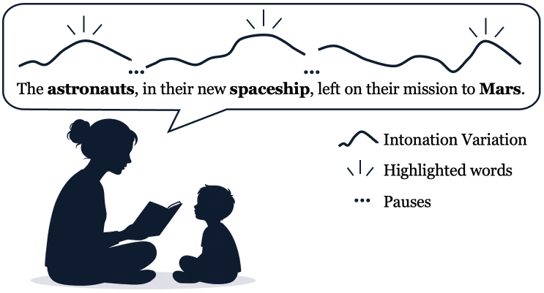
Reading with expression, or oral reading prosody, can help children better understand and engage with a story. Oral reading prosody refers to the way adults vary their voice when reading aloud through changes in pitch/intonation, loudness, speech rate, and pausing. These speech cues help highlight important words, signal the structure and meaning of sentences, and make stories easier for children to follow. Rather than reading in a flat voice, vary your pitch to reflect characters’ emotions, use different voices for dialogue, emphasize important words and phrases, and pause naturally at commas and periods. Expressive reading brings stories to life while also being associated with stronger storybook listening comprehension and broader language skills in young children (Davison et al., 2025).
Dialogic reading strategies
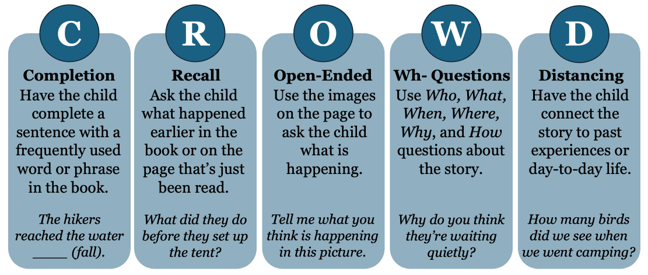
Dialogic reading is an evidence-based shared reading approach that encourages children to become active participants in the story. Rather than simply reading the text aloud, adults intentionally engage children in open-ended conversations about the book by asking questions, encouraging predictions, discussing illustrations, and expanding on children’s responses. One widely used approach is the PEER sequence which encourages adults to Prompt the child with a question, Evaluate and Expand on their responses, and Repeat new language to reinforce learning. To support the Prompt step, adults can use CROWD prompt types (see Figure 3) to ask a variety of questions that encourage the child to go beyond “yes” or “no” responses (Zevenbergen & Whitehurst, 2003). Together, these strategies invite children to think about the story, explain their ideas, and actively use language throughout the reading interaction.
Reading in multilingual contexts
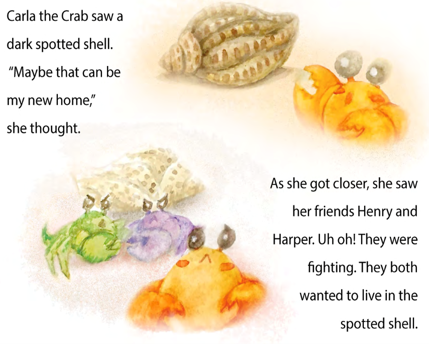
For multilingual families, shared reading provides a valuable opportunity to support children’s development in one or more languages. Caregivers can share books in a variety of languages or choose books that include multiple languages. When books are not available in a family’s identified language(s), caregivers can use English-language books not only by reading the text as written, but also by translating the text, or creating a story based on the illustrations (i.e., image-based storytelling).
Importantly, speaking, reading, and telling stories in the home language does not hinder children’s English reading development. Instead, growing evidence suggests that maintaining the home language supports bilingual language development, and many language and literacy skills acquired in one language can also contribute to reading development in others (Dong & Chow, 2022; Kremin et al., 2019; Morita-Mullaney et al., 2020). Thus, families can confidently engage in shared reading and other storytelling traditions in the language(s) spoken at home, recognizing that rich language experiences help build the foundational skills that support children’s later reading.
References
Carlisle, J. F. (2010). Effects of instruction in morphological awareness on literacy achievement: An integrative review. Reading Research Quarterly, 45, 464-487.
Davison, K. E., Strang, C., Gray-Bauer, H., Liu, T., & Zuk, J. (2025). Caregiver oral reading prosody Is associated with preschoolers’ storybook listening comprehension. Journal of Speech, Language, and Hearing Research, 68(12), 5950-5962.
Dong, Y., & Chow, B. W. Y. (2022). Home literacy environment and English as a second language acquisition: A meta-analysis. Language Learning and Development, 18(4), 485–499.
Justice, L. M., Pullen, P. C., & Pence, K. (2008). Influence of verbal and nonverbal references to print on preschoolers’ visual attention to print during storybook reading. Developmental Psychology, 44(3), 855–866.
Kremin, L. V., Arredondo, M. M., Hsu, L. S. J., Satterfield, T., & Kovelman, I. (2019). The effects of Spanish heritage language literacy on English reading for Spanish-English bilingual children in the US. International Journal of Bilingual Education and Bilingualism, 22(2), 192–206.
Leung, C. B. (2008). Preschoolers’ acquisition of scientific vocabulary through repeated read-aloud events, retellings, and hands-on science activities. Reading Psychology, 29(2), 165–193.
Morita-Mullaney, T., Renn, J., & Chiu, M. (2020). Obscuring equity in dual language bilingual education: A longitudinal study of emergent bilingual achievement, school course placements and grades. TESOL Quarterly, 54(3), 685-718.
Snowling, M. J., & Hulme, C. (2025). The reading is language model: A theoretical framework for language and reading development and intervention. Annual Review Developmental Psychology, 7. 195-218.
Zevenbergen, A. A., & Whitehurst, G. J. (2003). Dialogic reading: A shared picture book reading intervention for preschoolers. In A. van Kleeck, S. A. Stahl, & E. B. Bauer (Eds.), On reading books to children: Parents and teachers (pp. 177–200). Lawrence Erlbaum Associates Publishers.