How Teachers Can Apply Learning Theories to the Five Pillars of the Science of Reading
Jennifer Renn
Interest in the Science of Reading (SOR) has exploded in recent years, with 40 U.S. states and the District of Columbia passing laws or enacting policies requiring evidence-based reading instruction between 2013 and 2025 (Hagerman, 2024). SOR encompasses over 50 years of research on reading and writing development for learners of all ages, drawing on research from fields including education, psychology, linguistics, neuroscience, sociology, speech and language pathology, and implementation science. Focusing on the five pillars of phonics, phonological awareness, fluency, vocabulary, and comprehension, which are built on the essential foundation of oral language, it is based on a “large, diverse body of evidence that should be used to inform curriculum and pedagogy” rather than specific principles or practices (Lesaux & Carr, 2024, p.1).
Because SOR is rooted in a broad range of interdisciplinary research and covers several key competencies, classroom teachers may be overwhelmed and uncertain of how to best meet students’ needs. Perhaps because of this, many practitioners focus on phonics, or the relationship between sounds and letters, prioritizing it over the other pillars of SOR (Shanahan, 2020). There is also a tendency to use instructional strategies and techniques that include student repetition and recognition of information. While these approaches can help students learn to read and write, teachers should consider using a range of learning theories to better align instruction with learning goals. This brief provides some guidance on six learning theories and how they can be used to teach the pillars of SOR.
What are Learning Theories?
Learning theories describe how people acquire, process, and retain knowledge during the learning process. They guide teachers in developing effective, engaging instructional strategies by defining how learning is understood and interpreted. According to Schunk (2020), learning theories are differentiated based on (1) how learning occurs, (2) which factors influence learning, (3) the role of memory, (4) how transfer (i.e., applying the newly learned knowledge to other situations) occurs, and (5) the types of learning that are best explained by the theory. There are three main theoretical perspectives on learning: Behaviorism, Cognitivism, and Constructivism. Table 1 summarizes Ertmer and Newby’s (1993) evaluation of each of these perspectives.
| Summary of Three Main Theoretical Perspectives | Behaviorism | Cognitivism | Constructivism |
|---|---|---|---|
| How Learning Occurs | Learner’s behavior changes in response to stimulus | Learner organizing info and changes their state of knowledge | Learner creates meaning from experience |
| Factors that Influence Learning | Environmental factors are most important; learner factors (e.g., motivation, prior learning) are also considered | Environmental factors are emphasized; practice with feedback is important; learner factors (e.g., beliefs, attention) are important | Interaction between learner and environmental factors are critical |
| Role of Memory | Not considered | Learning occurs when information is stored in memory | Memory is not a focus because it is always changing |
| How Transfer Occurs | Learners generalize based on identical or similar features in new situations | When information is stored in memory and learner understands how to apply it in different contexts | Dependent on the learner’s experience on what they find personally meaningful |
| Best types of Learning | Recalling facts; making associations; generalizing | Reasoning; problem-solving; information-processing | More advanced, complex learning with authentic tasks |
Connecting Six Learning Theories to the Pillars of SOR
The three theoretical perspectives described above are the basis for a variety of learning theories. This brief focuses on six learning theories and how they relate to the components of SOR. Each theory and related instructional suggestions are discussed below.
Behaviorism
Behaviorism is a learning theory that views learning as a response to the environment. From an instructional perspective, this means providing students with immediate feedback and a positive consequence to reinforce a correct response. For example, a student may be praised by the teacher for answering a question correctly or might receive a sticker for following classroom procedures and raising their hand. Behaviorism works well for skills like remembering facts or making connections between two ideas, where responses are automatic. For SOR instruction, behaviorism is a good fit for teaching skills like:
- Associating letters with sounds (phonics)
- Identifying sounds (phonological awareness)
- Decoding (phonics)
Social Cognitive Theory
Social cognitive theory (Bandura, 2001) emphasizes that learning happens in a social environment where people interact with one another. According to this theory, students learn by watching their teachers or even peers, who model skills and behaviors, and then by doing the skills and behaviors themselves. The process of observing others and then enacting the learned information helps students develop self-efficacy, which is the belief that they are capable of performing and mastering the new skill. This approach is especially beneficial for SOR skills that require a lot of teacher demonstration and practice, like:
- Reading fluently and with expression (fluency)
- Developing reading confidence and self-efficacy (fluency)
- Think alouds that show students how to question the text or make predictions (comprehension)
Cognitive Learning Processes
Cognitive learning processes focus on the mental activities, like attention, perception, memory, and problem-solving, that are used during learning. These approaches are interested in learners’ “metacognition,” or how they think about their thinking. The learner is viewed as an active participant in the learning process, and learning occurs by connecting new information to existing knowledge structures, or schemas, which fosters understanding, motivation, and critical thinking. SOR-related activities and skills that align with this theory include:
- Making connections across meanings of words or phrases (vocabulary)
- Using analogies to make connections with previous patterns (phonics)
- Making meaningful connections to ideas and content (comprehension)
Cognitive Information Processing
Cognitive information processing (CIP) looks at how learners encode, organize, and retrieve information in their memories. Like cognitive learning processes, CIP is focused on the mind; however, rather than emphasizing what kinds of thinking support learning, CIP asks how information moves through the mind. There are many theories that fall into this category, but they all focus on the flow of information on during learning: Learners pay attention to new information, process it by relating the information previous knowledge, and store it in the long-term memory. Focusing on and remembering patterns helps reduce students’ cognitive load, making CIP approaches ideal for teaching SOR skills such as:
- Organizing CVC, CVCe, and vowel team patterns into categories (phonics)
- Understanding how affixes like -ed and -ing pattern and connect to base words (vocabulary)
- Chunking multisyllabic words (phonics, fluency)
Constructivism
Constructivism posits that learners construct knowledge through authentic experiences and form understandings based on their own experiences and social interaction. They are better able to remember information that is personally meaningful to them. Teachers can enact constructivist learning strategies by providing opportunities to engage with content and scaffolding their learning to support meaning-making. SOR skills that align with constructivism are:
- Exploring words in context, like through authentic texts (vocabulary)
- Discussing themes and interpreting texts in small groups (comprehension)
- Connecting texts to students’ lives and prior knowledge (comprehension)
Gagné’s Theory of Instruction
Finally, Gagné’s Theory of Instruction (Gagné, 1985) is a nine-step framework for guiding effective instruction. This approach can be used for any of the five SOR pillars. An example for phonics is:
- Gain attention with a word puzzle
- Provide a learning objective: “Decode CVCe words”
- Recall prior knowledge by talking about CVC patterns from prior lessons
- Present the material: CVCe pattern with examples
- Guide learning with visual markers and picture cards
- Practice decoding a variety of CVCe words
- Provide feedback on decoding accuracy
- Assess performance/understanding through independent word reading
- Support transfer by reading CVCe words in a text
Conclusion
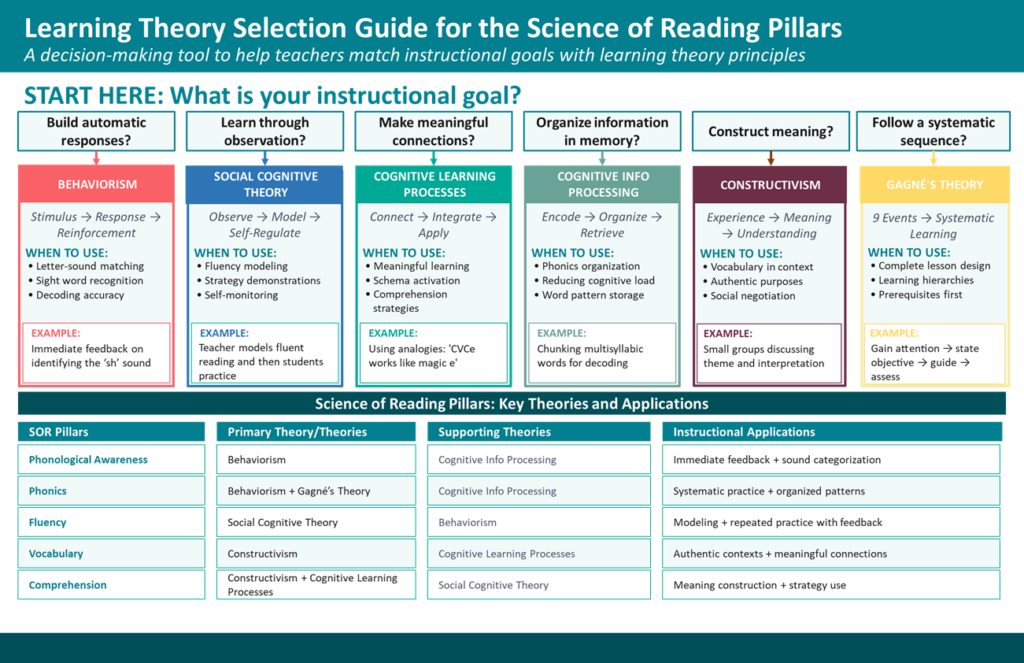
As shown above, no one learning theory is the best fit for all five SOR pillars; different learning theories are better aligned with some skills than others. For example, behaviorism works well for memorizing sounds and letters, while social cognitive theory is best-suited for skills that require extensive modeling, like fluent reading. Further, some skills can be taught through multiple learning theories; vocabulary, for instance, can be taught through cognitive learning processes, cognitive information processing, and constructivism approaches. To make these connections clearer, Figure 1 provides a decision-making tool to help teachers match their instructional goals with the six learning theory principles. This tool can help teachers engage in effective SOR instruction that is grounded in research, integrates multiple theoretical perspectives, and is responsive to students’ learning needs.
References
Bandura, A. (2001). Social cognitive theory: An agentic perspective. Annual Review of Psychology, 52(1), 1-26.
Ertmer, P. A., & Newby, T. J. (1993). Behaviorism, Cognitivism, Constructivism: Comparing Critical Features from an Instructional Design Perspective. Performance Improvement Quarterly, 6(4), 50–72. https://doi.org/10.1111/j.1937-8327.1993.tb00605.x.
Gagné, R. (1985). The Conditions of Learning and the Theory of Instruction (4th ed.). Holt, Rinehart, and Winston.
Hagerman, G. (2024, October 4). The “multiverse” of the Science of Reading. National Education Association. https://www.nea.org/nea-today/all-news-articles/science-of-reading#:~:text=Key%20Takeaways,passed%20laws%20on%20reading%20instruction.
Lesaux, N. K., & Carr, K. C. (2024). New York State Literacy Initiative Brief 1 of 7: Science of Reading: What is it? New York State Education Department.
Schunk, D. H. (2020). Learning theories: An educational perspective (8th ed.). Pearson.
Shanahan, T. (2020). The science of reading. The Reading Teacher, 74(2), 119-125.