Morita-Mullaney co-edits new book on Asian Americans in bilingual education
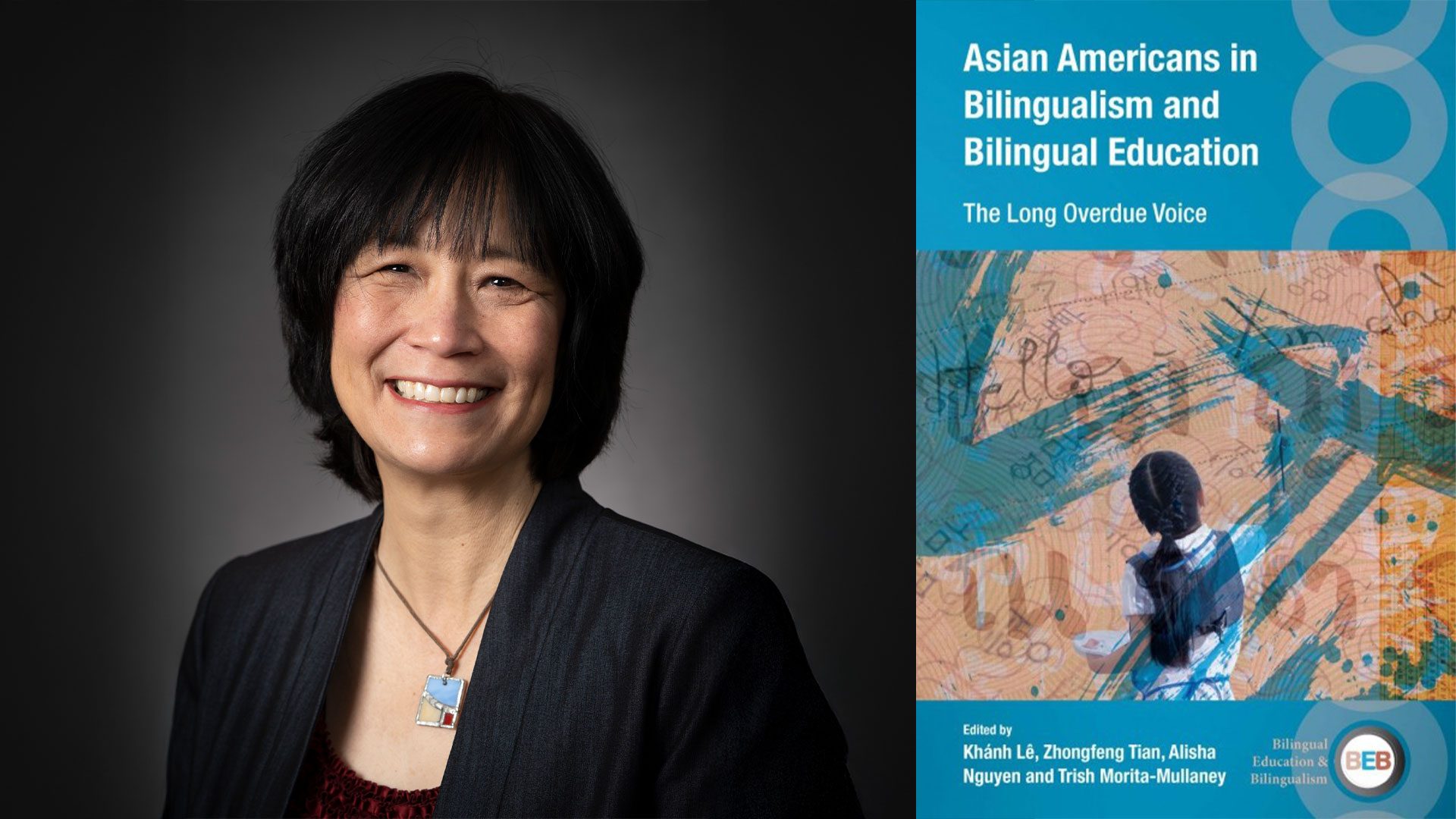
Trish Morita-Mullaney and her new book
Publication Title
Asian Americans in Bilingualism and Bilingual Education: The Long Overdue Voice
Author
Trish Morita-Mullaney, Khánh Lê, Zhongfeng Tian, and Alisha Nguyen (eds.)
Publisher
Multilingual Matters and Channel View Publications
Publication Date
December 16, 2025
About the Book
This book centers and amplifies the voices and complex lived experiences of Asian Americans in bilingual education. Drawing from the fields of bilingual education and ethnic studies, the chapters discuss language ideologies, anti-racist pedagogies, language loss and teacher and student experiences to explore how multilingualism is experienced distinctly by Asian Americans. Recognizing the heterogeneity within Asian American communities, the book highlights underrepresented Asian languages such as Hmong and Khmer and discusses both formal and informal education settings. It showcases a wide range of narratives and qualitative methodologies, employing critical theoretical frameworks such as AsianCrit, decoloniality, intersectionality, critical refugee studies, raciolinguistics, counterhegemonic pedagogies, humanization and transnationalism. As the first book fully dedicated to Asian American experiences in bilingual education, it broadens understandings of multilingualism and appeals to researchers, teacher educators and postgraduate students in applied linguistics, Asian American studies, higher education and bilingual education.
About the Author
Dr. Trish Morita-Mullaney is a professor in Language and Literacy Education at Purdue University. Her research focuses on the intersections between language, gender and race and how this informs the identity acts of educators of multilingual communities. Guided by critical and feminist thought, she examines how overlapping identities inform the logics of educational decision-making for multilingual families. Her newer line of research focuses on how Asian and Pacific Islander communities are pathologized as persistently foreign, thereby rationalizing implicit subjugation and erasure.