College faculty receive 3 NSF grants
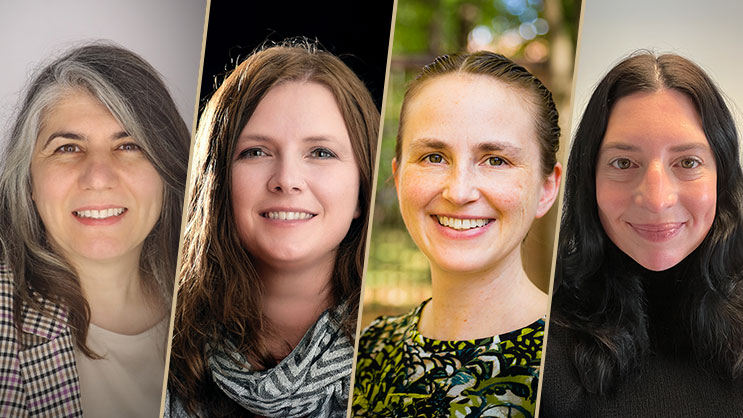
(l to r) S. Selcen Guzey, Rebekah Hammack, Laura Bofferding, and Stephanie Scherer
The National Science Foundation (NSF) awarded grants totaling over $3.2 million to four College of Education faculty members in August.
The NSF awarded Purdue University a $1.99 million grant for the Microelectronics Master Teacher Fellowship Program, led by Greg Strimel (PI) from the Purdue Polytechnic Institute, with Co-PIs Tamara Moore and Morgan Hynes from the School of Engineering Education, and the College of Education’s S. Selcen Guzey (Co-PI), Department Head of Curriculum and Instruction and professor of science education.
The project will prepare K–12 teacher leaders to bring advanced knowledge of microelectronics into classrooms and inspire the next generation of STEM professionals. They will continue the Scalable Asymmetric Lifecycle Engagement (SCALE) K-12 microelectronics workforce development initiative efforts to bring advanced knowledge of microelectronics into classrooms and inspire the next generation of STEM professionals. The five-year project will run from October 2025 through September 2030 as part of NSF’s Robert Noyce Teacher Scholarship Program, recruiting and preparing 15 practicing teachers as Microelectronics Master Teacher Fellows to serve high-need districts.
Rebekah Hammack (PI), assistant professor of science education, and Stephanie Scherer (Co-PI), clinical assistant professor of curriculum studies, received a $502,000 NSF grant for Understanding the Impact of Professional Learning Programs on Teacher Decision Making and Practice.
Professional learning (PL) programs are widely used to disseminate research-based instructional principles to educators with the goal of improving classroom teaching and student outcomes, but little is known about how teachers engage with and use the information they acquire once the formal training is completed. This project addresses that gap by examining teachers’ experiences and decision-making processes as they interpret, adapt, implement, or disregard PL content after training concludes.
“Unfortunately, current models of knowledge translation within education present elements ‘done to’ the practitioner and lack the role of the teacher as an active agent in the knowledge generation and translation process,” Hammack said. “Our study contributes a much-needed lens to existing models by centering the role of the teacher as an active agent, acknowledging the knowledge, expertise, collaboration, and context that shape how knowledge is transformed and delivered to students.”
Source: Rebekah Hammack
Laura Bofferding (PI), professor of mathematics education, was awarded a three-and-a-half-year $788,393 grant from the National Science Foundation (DRK-12) for the project Design and Development of Integer Games to Reduce Barriers to Algebra. Dr. Mahtob Aqazade (Illinois State University), and Dr. Nicole M. Enzinger (George Fox University) are Co-PIs.
The purpose of the four-year grant is to design and develop a series of six integer games that can be used to introduce elementary students to negative number concepts. Through this work, researchers will learn more about students’ learning of negative numbers and identify game mechanics that can support motivation, engagement, and mathematical learning.
“Students often feel lied to when they finally learn that there are numbers less than zero,” Bofferding said. “I feel it is important to help them understand the structure of the number system early on, which in turn can foster their mathematical wonder and better prepare them for later mathematics.”
Source: Laura Bofferding