Linguistic Knowledge for Teachers:Supporting Multilingual Learners in the Science of Reading Era
Brenda Sarmiento Quezada, Ph.D. Assistant Professor, Purdue University
Introduction
The Science of Reading (SOR) is intended to benefit all children as they develop foundational skills in reading. For students who bring proficiencies in languages and dialects other than Standard English, their experience of SOR instruction often differs. These learners draw upon diverse linguistic repertoires, ranging from varied sound systems to complex morphological and syntactic structures, that shape how they engage with classroom activities such as phonics, decoding, and comprehension. This research brief highlights the importance of teachers’ linguistic knowledge in ensuring that SOR-aligned instruction distinctly and equitably serve multilingual learners. The brief provides an overview of six areas of linguistics (Figure 1: phonology, morphology, syntax, semantics and pragmatics, and dialect awareness) that are directly connected to reading instruction. Each section reviews why these areas matter for literacy development and offer practical implications for classroom practice.
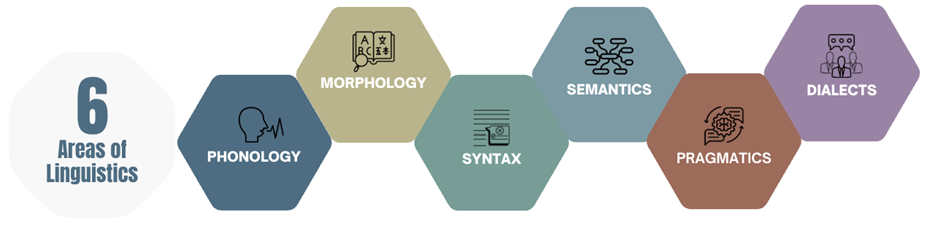
Core Areas of Linguistic Knowledge Teachers Need
Phonology
Phonology refers to the sound systems of languages. In reading instruction, phonology is tied to phonemic awareness (the ability to identify and manipulate sounds in spoken language) and phonics (the mapping of sounds to print). English has a relatively large and complex inventory of vowel and consonant sounds compared to many other languages . For example, in Spanish there are five pure vowel sounds (/a/, /e/, /i/, /o/, /u/) that are always pronounced the same way, regardless of context. In contrast, English vowels have multiple pronunciations depending on their position and surrounding consonants (e.g., the “a” in cat, cake, and car). This variability in English vowels creates additional challenges for multilingual learners whose home language vowels map consistently.
Why it matters for reading
Multilingual students’ knowledge of sound systems in their home languages shapes how they acquire English phonics. For example, Spanish-speaking children may not distinguish between short and long vowels in English, while students whose languages lack the “th” sound (e.g., Korean, Gujarati) may substitute other sounds. Such transfer patterns are normal, not errors, and influence how students decode and spell in English (Cummins, 2001, 2021; Shanahan & Beck, 2006). Teachers who understand these differences are better able to distinguish between language transfer and genuine reading difficulties
Practice implications
- Provide explicit instruction in sounds unique to English;
- Use visual/tactile supports (e.g., mouth diagrams, hand signals) to demonstrate articulation;
- Highlight similarities and differences between English and students’ home languages; and
- Focus on consistent sound–symbol mapping rather than accent.
Morphology
Morphology is the study of word parts, such as roots, prefixes, and suffixes, and how they combine to form meaning. Morphological awareness plays a critical role in vocabulary, word recognition, spelling, and reading comprehension.
Why it matters for reading
Research shows that explicit morphological instruction improves reading outcomes for multilingual learners. Spanish-English bilinguals, for example, benefit from cognates and shared affixes across languages, which facilitate cross-linguistic transfer (Ramirez et al., 2013). For instance, teaching the root tele- (meaning “distance”) helps students recognize connections across words like telephone, television, and telegraph. Spanish speakers can also connect this to the cognate teléfono, reinforcing meaning while building decoding skills. Similarly, highlighting suffixes such as -ción in Spanish and -tion in English helps students see how word families span across languages. Instruction that emphasizes morphemes helps students decode complex words, expand vocabulary, and strengthen comprehension (Kim et al., 2015; Koda & Zehler, 2008).
Practice implications
- Teach common roots, prefixes, and suffixes in both English and students’ home languages;
- Leverage cognates to expand vocabulary (e.g., familia/family);
- Encourage word analysis strategies for decoding multisyllabic words; and
- Integrate morphology into spelling and reading and listening comprehension instruction.
Syntax
Syntax is the set of rules that govern sentence structure. Reading comprehension depends on students’ ability to parse and make sense of increasingly complex sentences found in academic texts. For example, English texts often use embedded clauses, such as “The boy who was wearing a red hat ran quickly.” Students whose home languages typically use shorter or less embedded structures (e.g., in Mandarin or Spanish) may initially struggle to keep track of the main idea while processing the additional information. Explicitly teaching students to identify the main clause and supporting details can help them better understand these kinds of sentences.
Why it matters for reading
Multilingual bilingual students often need support with English syntax, which can differ significantly from their home language structures. For example, adjective–noun order (e.g., “red car” in English vs. “carro rojo” in Spanish) or subject–verb agreement can impact listening and reading comprehension and writing. Explicit instruction in syntax improves students’ ability to navigate complex texts and supports higher-level reading comprehension (Cummins, 2005; Escamilla et al., 2014; Kim et al., 2015).
Practice implications
- Break down and model complex sentences from grade-level texts;
- Provide sentence frames and stems to scaffold comprehension and production;
- Compare and contrast sentence structures in English and students’ home languages; and
- Use oral language practice (e.g., retelling, paraphrasing) to strengthen syntactic awareness.
Semantics and Pragmatics
Semantics refers to how words and sentences convey meaning, including vocabulary knowledge, multiple-meaning words, and relationships among words. Pragmatics refers to how language is used in context, such as making inferences, understanding figurative language, and shifting between informal and academic registers. For example, a child learning English may read the sentence “It’s raining cats and dogs” and picture animals falling from the sky. Without explicit instruction in idiomatic language and pragmatic use, the intended meaning (“It’s raining heavily”) can be lost, which affects comprehension.
Why it matters for reading
Vocabulary and comprehension are core pillars of the Science of Reading, yet multilingual learners often face challenges when semantic and pragmatic aspects of language are overlooked. Students may misinterpret words with multiple meanings (e.g., “bat” as an animal vs. a sports tool), struggle with false cognates (e.g., embarazada in Spanish meaning “pregnant,” not “embarrassed”), or miss pragmatic cues in figurative expressions and idioms. In addition, cultural norms shape how students use and interpret language in different contexts, for instance, expectations about when to speak in class or how to respond to questions. Teachers who understand these layers can better support comprehension and equitable participation (Cummins, 2001, 2021; Duke & Cartwright, 2021; García & Kleifgen, 2019; Lightbown & Spada, 2013).
Practice implications
- Teach multiple word meanings and highlight cross-linguistic similarities and differences, including cognates (words that share meaning and form across languages, such as animal in English and animal in Spanish) and false cognates (words that look similar across languages but have different meanings, such as éxito in Spanish meaning “success,” not “exit”);
- Use texts that include figurative language and model strategies for interpreting idioms, metaphors, and humor;
- Provide explicit instruction in academic register while affirming home and community language practices; and
- Create opportunities for oral discussion that validate diverse pragmatic norms (e.g., turn-taking, narrative styles), ensuring all students can engage meaningfully.
Dialects and Language Variation
All languages have dialects and varieties, including English (e.g., African American English, Appalachian English, Chicano English). These are systematic, rule-governed, and legitimate forms of communication. For example, in Chicano English, a student might pronounce the word school as [es’kul] by adding an initial vowel sound before the /s/ cluster, reflecting Spanish-influenced phonotactics. In addition, Chicano English speakers often use the word barely to mean “just recently,” as in “I barely ate” to mean “I just ate.” Both are features of the dialect, not errors.
Why it matters for reading
Students may bring dialectal features that differ from “standard” school English (e.g., final consonant cluster reduction, habitual “be”). Without linguistic knowledge, teachers may mistake these features for reading errors or deficits. Recognizing dialect differences prevents misidentification of reading difficulties and affirms students’ identities (Aukerman & Chambers Schuldt, 2021; Goldenberg, 2013, 2020;).
Practice implications
- Distinguish between dialect differences and decoding/spelling errors
- Validate students’ home dialects while teaching code-switching for academic contexts;
- Use texts that reflect students’ linguistic and cultural identities; and
- Provide professional development for teachers on dialect diversity and literacy.
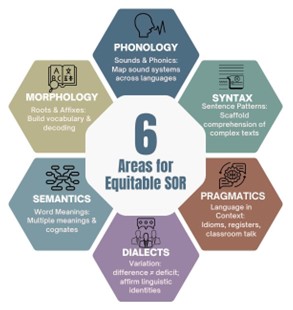
Practice Implications for Equitable SOR
Teachers do not need to be linguists or language specialists to effectively apply the Science of Reading with multilingual students. However, developing a working knowledge of how languages differ equips educators to make more informed instructional choices. The following practice implications can support equitable implementation of SOR across linguistically diverse classrooms:
- Phonology: Provide explicit practice with sounds unique to English while drawing connections to students’ home languages. Use visual and kinesthetic supports to reinforce articulation.
- Morphology: Highlight word parts (roots, prefixes, suffixes) across languages. Leverage cognates and word families to expand vocabulary and comprehension.
- Syntax: Scaffold complex sentences from grade-level texts. Compare sentence patterns across languages and use oral language activities to build syntactic awareness.
- Semantics and Pragmatics: Teach multiple word meanings, figurative language, and cross-linguistic similarities/differences. Use culturally responsive texts and explicitly model how language use shifts across contexts (e.g., home vs. school, informal vs. academic).
- Dialects: Recognize dialectal features (e.g., African American English) as systematic, not deficient. Differentiate between variation and true reading difficulties.
These strategies are most effective when embedded in everyday literacy instruction rather than treated as add-ons. Teachers who adopt a linguistically informed lens can better identify transfer patterns, provide targeted support, and build on the full range of students’ linguistic strengths (August & Shanahan, 2006; Wright, 2025).
Conclusion and Implications
Equitable implementation of the Science of Reading requires more than a focus on phonics, phonemic awareness, fluency, vocabulary, and comprehension. For multilingual learners, teachers’ knowledge of language—across phonology, morphology, syntax, semantics, pragmatics, and dialect variation—is essential for interpreting student progress and tailoring instruction. Without this lens, predictable language transfer and dialectal differences may be misidentified as reading difficulties, and opportunities to build on students’ linguistic resources may be missed.
Teacher preparation and professional development must therefore include a stronger emphasis on linguistics for educators. Research has shown that multilingual learners benefit when instruction explicitly connects features of their home languages to English, leverages cross-linguistic transfer, and validates diverse ways of using language (Cummins, 2001, 2021; Escamilla et al., 2014; García & Wei, 2014; The Reading League Summit, 2023; Wright, 2025). Professional learning that equips teachers with this knowledge can help ensure that SOR-aligned practices serve all students rather than reinforcing monolingual, one-size-fits-all approaches.
At the policy and school level, building linguistically informed literacy instruction also requires access to culturally and linguistically responsive curricula, materials that reflect students’ languages and identities, and assessments that recognize difference versus disorder. Supporting teachers in developing this expertise will not only strengthen literacy outcomes but also affirm the identities of multilingual learners, ensuring they are both seen and heard in the classroom.
In short, advancing the Science of Reading in linguistically diverse classrooms depends on preparing educators to see language as a resource. By embedding linguistic knowledge into teacher preparation, professional development, and instructional design, schools can foster literacy instruction that is both scientifically grounded and socially just.
References
Aukerman, M., & Chambers Schuldt, L. (2021). What matters most? Toward a robust and socially just science of reading. Reading Research Quarterly, 56(S1), S85-S103. https://doi.org/10.1002/rrq.406
August, D., & Shanahan, T. (Eds.). (2006). Developing literacy in second-language learners: Report of the National Literacy Panel on language-minority children and youth. Lawrence Erlbaum.
Cummins, J. (2001). Negotiating identities: Education for empowerment in a diverse society (2nd ed.). Multilingual Matters.
Cummins, J. (2005). Teaching for transfer: Challenging the two solitudes assumption in bilingual education. In T. Skutnabb-Kangas & H. C. Hornberger (Eds.), Encyclopedia of language and education (pp. 1521-1535). Springer.
Cummins, J. (2021). Rethinking the education of multilingual learners: A critical analysis of theoretical concepts. Multilingual Matters.
Duke, N. K., & Cartwright, K. B. (2021). The science of reading progresses: Communicating advances beyond the simple view of reading. Reading Research Quarterly, 56(S1), S25–S44. https://doi.org/10.1002/rrq.411
Escamilla, K., Hopewell, S., Butvilofsky, S., Sparrow, W., Soltero-González, L., Ruiz-Figueroa, O., & Escamilla, M. (2014). Biliteracy from the start: Literacy squared in action. Caslon Publishing.
García, O., & Kleifgen, J. A. (2019). Educating emergent bilinguals: Policies, programs, and practices for English learners (2nd ed.). Teachers College Press.
García, O., & Wei, L. (2014). Translanguaging: Language, bilingualism and education. Palgrave Macmillan.
Goldenberg, C. (2013). Unlocking the research on English learners: What we know—and don’t yet know. American Educator, 37(2), 4-11.
Goldenberg, C. (2020). Reading wars, reading science, and English learners. Reading Research Quarterly, 55(51), S131-S144. https://doi.org/10.1002/rrq.340
Kim, T. J., Kuo, L. J., Ramírez, G., Wu, S., Ku, Y. M., de Marin, S., Eslami, Z. (2015). The relationship between bilingual experience and the development of morphological and morpho-syntactic awareness: a cross-linguistic study of classroom discourse. Language Awareness, 24(4), 332–354. https://doi.org/10.1080/09658416.2015.1113983
Koda, K., & Zehler, A. M. (2008). Learning to read across languages: Cross-linguistic relationships in first- and second-language literacy development. Routledge.
Lightbown, P., & Spada, N. M. (2013). How languages are learned (4th ed.). Oxford University Press.
Ramirez, G., Chen, X., & Pasquarella, A. (2013). Cross-linguistic transfer of morphological awareness in Spanish-speaking English language learners: The facilitating effect of cognate knowledge. Topics in Language disorders, 33(1), 73-92. https://www.doi.org/10.1097/TLD.0b013e318280f55a
Shanahan, T., & Beck, I. (2006). Effective literacy teaching for English-language learners. In D. August & T. Shanahan (Eds), Developing literacy in second-language learners: Report of the national literacy panel on language-minority children and youth (pp. 415–488). Lawrence Erlbaum Associates, Publishers.
The Reading League Summit. (2023). Joint Statement of The Reading League and NCEL – Understanding the difference: The science of reading and implementation for English learners/emergent bilinguals (ELs/EBs). The Reading League and National Center for Effective Literacy Instruction for English Learner/Emergent Bilingual Students. https://multilingualliteracy.org/wp-content/uploads/2023/10/Joint-Statement_SOR-EL_EB.pdf Wright, W. E. (2025). Foundations for teaching English language learners: Research, theory, policy, and practice (4th ed.). Brookes Publishing.