About

Programs
Enhancing Literacy and Language Instruction
Support the Center’s Research and Activities

Research Initiatives


The Reading Forum

Read to Succeed

Literacy and Language Development Clinics
Purdue’s Literacy and Language Development Clinics (LLDC) offer an array of service options tailored to individual school populations’ needs, and resources for literacy and language development for grades K-6. Clinical services include needs assessment, screening, and one-on-one Intervention.

Teacher Release Project
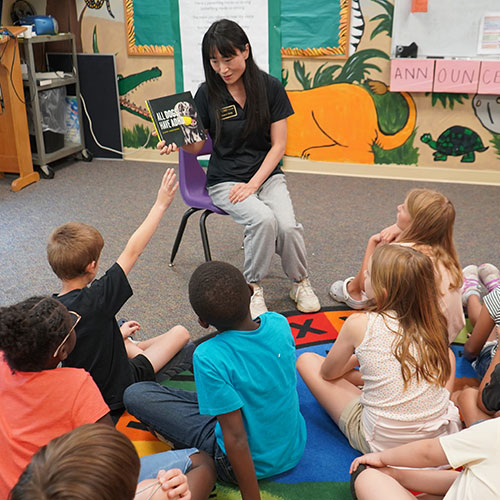
The Teacher Release Project offers school districts up to one hour of teacher release time per month per classroom while Purdue educators lead classrooms in research-based reading and writing activities (given parent/guardian permission and child assent).

Advancing Science of Reading (SoR) in Indiana
Research Briefs
CL²EAR Briefs are a series of short reports that address topics of interest related to literacy and language education. They are intended to provide educators, administrators, and policymakers with an overview of research and practical applications on current issues in the field. CL²EAR Briefs can be accessed below.

Learning to Read while Learning a Language: Reading and English Learners
The Science of Reading (SOR) is intended to benefit all children as they develop a strong foundation in reading. For a growing number of students who have proficiencies in languages other than English, how they experience SOR classroom activities differs. Students who are learning English as an additional language come from a variety of language backgrounds and enter at different levels of English proficiency, ranging from beginner to advanced. This research brief provides a linguistic landscape of Indiana’s K-12 students, followed by a review of the research on how certain components of reading (phonemic awareness, phonics, and fluency) are different for identified-English learners (ELs).
Knowledge of Morphological Structure and its connection to reading and writing
Within the body of literature that provides sound evidence of reading and writing development and disorders, knowledge of morphological structure has been found to play a crucial role. Specifically, awareness of morphological structure (e.g., morphological awareness) serves as an avenue for improving vocabulary, word reading, spelling and reading comprehension. This research brief provides an overview of morphology and morphological awareness, why it is important for reading and writing, how morphological awareness contributes to the aforementioned skills, and considerations for non-native English speakers.
Morphological Awareness: An avenue for improving vocabulary, word recognition, spelling and reading comprehension
Learning requires the integration of many skills, with language development being a crucial foundational aspect. Language development across five domains-phonology (the sounds within a language), morphology (word structure/formation), semantics (word meaning), syntax (sentence structure/grammar), and pragmatics (use in varying contexts)-unequivocally supports the acquisition of reading and writing skills. Specifically, morphological knowledge is vital for improving vocabulary, word recognition, spelling and reading comprehension. This practice brief provides an overview of morphological awareness and derived words, provides a rationale for teaching morphological awareness, and instructional strategies supported by science.
The ABCs of Learning the ABCs
A fundamental aspect of learning to read is mastering the ABCs. This includes recognizing the letter names and their corresponding sounds. In some classrooms, the focus is on memorizing each letter name and sound, with equal attention to each letter. Researchers have demonstrated that children’s letter learning is influenced by many factors. Some of these may be obvious, but others are less so. Understanding how letter learning takes place is practically useful as parents and teachers impart this critical skill to their children (McBride, in press).
Neurodiversity in Action Understanding the brain basis of dyslexia
Dyslexia, a specific learning disability (SLD) characterized by word reading impairment, is commonly misunderstood as a disorder in which learners simply reverse their letters, like b and d. Research in cognitive neuroscience tells a different story, and can help us to target our instruction to better serve struggling readers.
Linguistic Knowledge for Teachers:Supporting Multilingual Learners in the Science of Reading Era
The Science of Reading (SOR) is intended to benefit all children as they develop foundational skills in reading. For students who bring proficiencies in languages and dialects other than Standard English, their experience of SOR instruction often differs. These learners draw upon diverse linguistic repertoires, ranging from varied sound systems to complex morphological and syntactic structures, that shape how they engage with classroom activities such as phonics, decoding, and comprehension. This research brief highlights the importance of teachers’ linguistic knowledge in ensuring that SOR-aligned instruction distinctly and equitably serve multilingual learners. The brief provides an overview of six areas of linguistics (Figure 1: phonology, morphology, syntax, semantics and pragmatics, and dialect awareness) that are directly connected to reading instruction. Each section reviews why these areas matter for literacy development and offer practical implications for classroom practice.
A Quick Start Guide to Science of Reading Aligned Textbooks for Literacy Instruction
Educator preparation programs (EPPs) across the country are shifting their literacy curricula to align with the research-based approaches of the “Science of Reading” (SoR). With this change comes the challenge of selecting textbooks and other course materials that will ensure effective classroom practices. This brief aims to provide a quick starting point for identifying literacy textbooks and materials. The books listed in this brief were part of a discussion at The Reading League – Indiana Higher Education Collaboration during its September 2025 meeting. Colleagues from different disciplines shared their interests and preferences for books to teach reading, both at basic and more advanced levels. The Reading League has colleagues in the areas of literacy/reading education, curriculum and instruction, special education, speech and hearing sciences, human development and family science, early childhood education, and other specialties. We teach undergraduate and graduate courses. Our list is not by any means comprehensive, and we acknowledge that what works for one course or audience may not work for another. This list begins with comprehensive textbooks that focus on building the foundation for SoR-aligned literacy instruction. The list then provides more information on specific areas of literacy learning. Please note that the ratings from the National Council on Teaching Quality (NCTQ) (n.d.) are listed in parenthesis between the title and author(s) whenever possible. NCTQ has a 3-point rating scale. According to their scale, a 1 indicates that the book is unacceptable according to certain SoR standards that they have set. Two as a rating indicates that the book is acceptable according to these standards. A label of “exemplary” is given for books with a 3 on this scale. Please keep these in mind as you consider these books. Also, please note that some of these books have not been rated by NCTQ or, in certain circumstances, not all editions of the book have been rated. We have indicated the closest rated edition’s rating in these cases, and we have labeled unreviewed books as (not reviewed). The popularity ranking seems to be based on the number of identified courses that use a particular book out of the 1961 materials reviewed.
Classroom Libraries as Sites of Literacy, Identity, and Imagination: A PK–3 Guide
We are teaching young children in a moment of contradiction. Decades of literacy research demonstrate that abundant access to books is one of the strongest predictors of early reading development, vocabulary growth, and long-term academic success (Allington, 2014; Neuman & Celano, 2012). This body of research consistently shows that children who have frequent opportunities to read self-selected texts encounter more words, develop broader background knowledge, and read with greater fluency over time. In other words, access itself functions as an instructional condition, not a peripheral support.
How Teachers Can Apply Learning Theories to the Five Pillars of the Science of Reading
High Stakes Literacy Testing Indiana’s IREAD-3
Artificial Intelligence in Literacy Education
Artificial intelligence (AI) tools are entering K–12 classrooms at a remarkable pace. 86% of educational organizations use generative AI, the highest of any industry in the United States (Microsoft, 2025) Yet, this high rate of adoption is not being matched by a high rate of scientific certainty. Most AI-based educational tools have not undergone independent validation, and few have been tested through rigorous methods such as randomized controlled trials. AI capabilities are advancing so rapidly that traditional research cycles struggle to keep pace, forcing educators to be very critical consumers. This brief is intended to give educators an accessible framework for introducing and evaluating artificial intelligence tools in the classroom.
Motivating K-12 Students to Read Independently
Studies that highlight the impact of reading motivation offer great insight for engaging K–12 learners within literacy.
Work With Us
Undergraduate Students and In-Service Teachers
We hire undergraduate preservice and in-service teachers. If you have taken 300 level literacy and language teaching methods coursework in the College of Education or equivalent and would like to work children one-on-one as a literacy/language clinic tutor, please contact us for training and placement.
Graduate Students
We are recruiting graduate students! If you are a current or potential graduate student interested in literacy or language education and would like to be involved with any CL²EAR-affiliated research projects, please contact us.
Teachers and Schools
We partner with teachers and schools. If you are interested in training, license additions, professional development or school-based research partnership, please contact us.

Our Team
Administration
Affiliated Faculty, Staff, and Graduate Students
Contact Us